Most Popular Research Peptides in the UK: A 2026 Guide

This content is for laboratory research purposes only. Not for human or animal use.
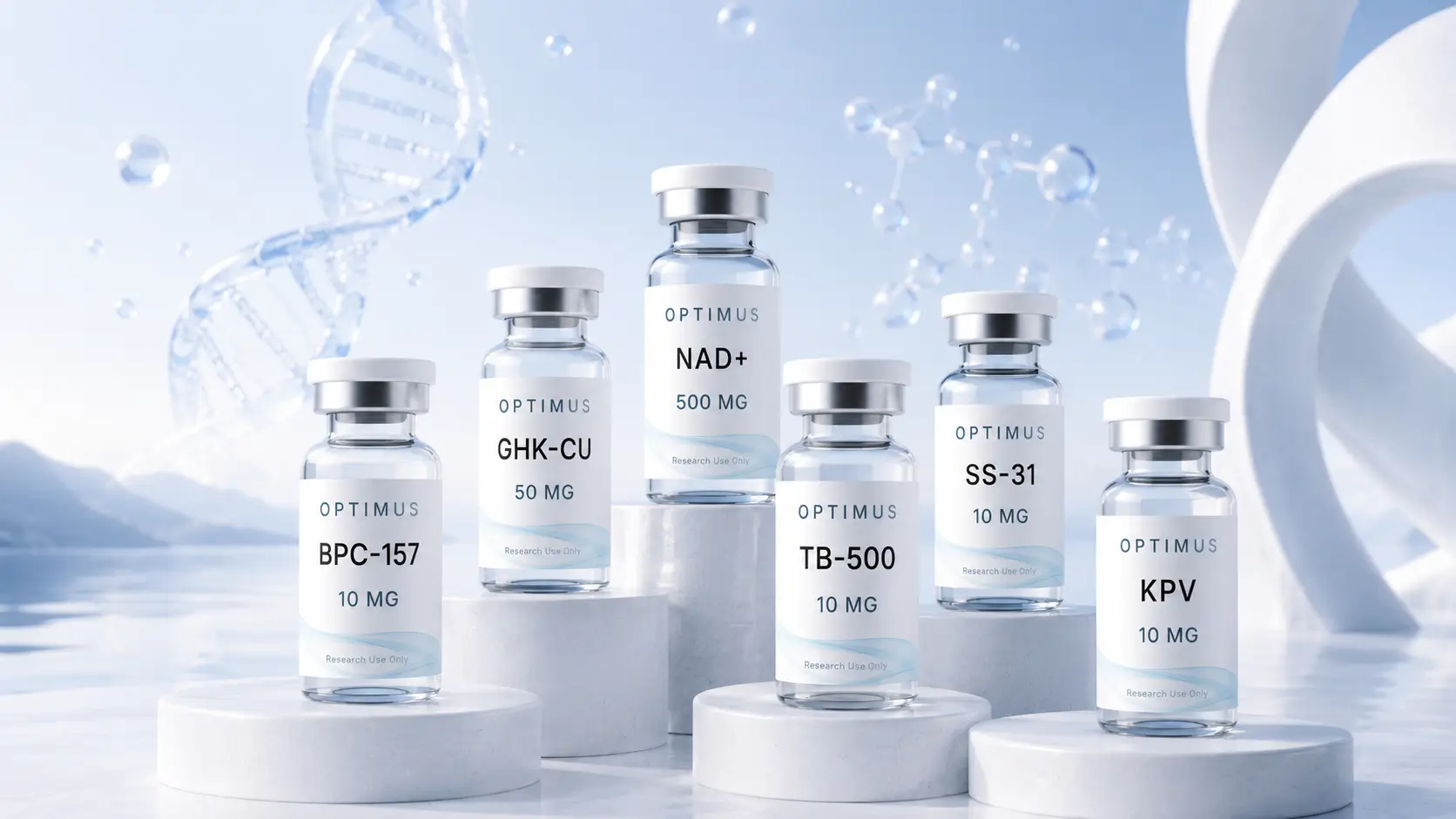
Research peptides are studied in laboratories across the UK for their potential applications in tissue repair, cellular regeneration and metabolic research. This guide gives an overview of the most popular research peptides UK laboratories currently work with — their key characteristics, research applications and the purity standards that matter — and links to a detailed guide and product page for each.
Table of Contents
BPC-157 — Tissue Repair and Angiogenesis
BPC-157 (Body Protection Compound-157) is one of the most studied research peptides UK researchers work with. It is a 15-amino-acid pentadecapeptide derived from a protein found in gastric juice, notable for its stability at low pH. Common research applications include tissue repair and regeneration, angiogenesis studies and inflammatory-pathway research. Purity: ≥98% HPLC; molecular weight ~1,419.6 g/mol. Read the full BPC-157 guide.
TB-500 — Wound Healing and Cell Migration
TB-500 is a synthetic fragment of Thymosin Beta-4, a protein found in all cells, known for its role in cell migration and tissue repair. Common research applications include wound-healing studies, angiogenesis research, and actin regulation. Purity: ≥98% HPLC; molecular weight ~4,964.4 g/mol. Read the full TB-500 guide, or compare the two in our BPC-157 vs TB-500 section.
GHK-Cu — Collagen Synthesis and Copper Peptide Research
GHK-Cu (Copper Tripeptide-1) is a naturally occurring copper complex first identified in human plasma in 1973, composed of three amino acids bound to a copper ion. Common research applications include collagen and elastin synthesis, hair-follicle studies, and antioxidant research. Purity: ≥98% HPLC; molecular weight ~340.9 g/mol. Read the full GHK-Cu guide.
NAD+ Precursors — Cellular Energy and Ageing Research
NAD+ (Nicotinamide Adenine Dinucleotide) is a coenzyme found in all living cells. Precursors such as NMN and NR are widely studied in UK laboratories for cellular energy metabolism, ageing and longevity research, and neurodegenerative disease models. Purity: ≥98% HPLC. For a related metabolic compound, see our guide to 5-Amino-1MQ. Full background in our NAD+ guide.
SS-31 — Mitochondrial Function Research
SS-31 (Elamipretide) is a mitochondria-targeted peptide studied for its role in mitochondrial function and cellular energy production. Common research applications include mitochondrial research, cellular energetics, and ageing and metabolic studies. Purity: ≥98% HPLC; molecular weight ~639.8 g/mol. Full background in our SS-31 guide.
KPV — Inflammation and Immune Response Research
KPV is a tripeptide composed of lysine, proline and valine, studied for its potential role in modulating inflammatory pathways. Common research applications include inflammatory-response research, immune-modulation studies, and cytokine-pathway analysis. Purity: ≥98% HPLC; molecular weight ~370.5 g/mol. Full background in our KPV guide.
Which Peptide Is Right for Your Research?
The table below summarises how the most popular research peptides UK laboratories use compare at a glance:
| Compound | Primary research area | Key mechanism |
|---|---|---|
| BPC-157 | Tissue repair | Angiogenesis, growth factors |
| TB-500 | Wound healing | Actin binding, cell migration |
| GHK-Cu | Collagen synthesis | Copper-ion delivery |
| NAD+ precursors | Cellular energy | Metabolic pathways |
| SS-31 | Mitochondrial function | Mitochondrial targeting |
| KPV | Inflammatory response | Immune modulation |
| Ipamorelin | Growth hormone release | Ghrelin-receptor selectivity |
| Tesamorelin | Growth hormone release | GHRH-receptor analogue |
| CJC-1295 (No DAC) | Growth hormone release | GHRH-receptor analogue |
| IGF-1 LR3 | Cellular proliferation | IGF-1 receptor, reduced IGFBP binding |
| MOTS-c | Metabolic regulation | Mitochondrial-derived peptide |
| Semax | Neurochemical signalling | ACTH(4-10) analogue |
| Selank | Neurochemical signalling | Tuftsin analogue |
| Thymosin Alpha-1 | Immune modulation | Thymic peptide signalling |
| Epitalon | Cellular ageing | Telomerase-pathway research |
| 5-Amino-1MQ | Metabolic regulation | NNMT inhibition |
Why Purity Matters in Research Peptides
The same purity standards apply across research peptides UK suppliers should meet. In laboratory research, purity directly affects experimental outcomes. Impurities such as truncated sequences, residual solvents or oxidation products can interfere with assay results. When sourcing a research peptide, look for:
- ≥98% HPLC purity
- Mass-spectrometry confirmation of identity
- A Certificate of Analysis (COA) with each batch
- Storage at -20°C, protected from light and moisture (see our guide on how to store peptides)
- Batch-tested, traceable material
See why peptide purity matters for more detail on HPLC verification and reproducibility.
Where to Find High-Purity Research Peptides in the UK
Optimus Labs supplies high-purity research peptides UK laboratories rely on, batch-tested and HPLC-verified, with a Certificate of Analysis confirming purity, molecular weight and peptide sequence. Orders ship from the UK with tracked delivery, and every peptide needs a solvent — see our guide to bacteriostatic water for reconstitution. Browse the full research catalogue to explore the range.
Beyond the compounds above, the Optimus Labs catalogue also includes CJC-1295 without DAC, Epitalon, GHRP-6, IGF-1 LR3, Ipamorelin, MOTS-c, Selank, Semax, Tesamorelin and Thymosin Alpha-1.
Each of these has its own research overview: Ipamorelin, Tesamorelin, IGF-1 LR3, Semax, MOTS-c, Selank, Thymosin Alpha-1, CJC-1295 and Epitalon.
Frequently Asked Questions
What are research peptides used for?
They are used in laboratory settings to study cellular processes, tissue repair and metabolic pathways. They are supplied strictly for research use, not for human or animal use.
What purity should I look for?
For most applications, ≥98% HPLC purity is recommended; ≥99% is preferred for sensitive assays, confirmed by a batch Certificate of Analysis.
How should peptides be stored?
Store lyophilised peptides at -20°C, protected from light and moisture. Once reconstituted, aliquot and store at -80°C for long-term storage.
What is a Certificate of Analysis?
A COA is a document confirming the purity, molecular weight and identity of a specific peptide batch.
Can peptides be used in cell culture?
Yes, provided the material is sterile and endotoxin-tested for live-cell experiments.
Which compound should a new research project start with?
That follows from the research question rather than from the compound. The comparison table above groups each one by its primary research area, so the usual starting point is to identify the pathway under investigation and work back from there. Compounds within the same area are not interchangeable, and results obtained with one should not be assumed to carry across to another.
Do different batches of the same peptide behave the same way?
Not automatically. A Certificate of Analysis describes the batch that was tested, not the product line as a whole, which is why batch numbers belong in the experimental record. Quoting the batch alongside results is what allows another laboratory to compare its findings against yours on equal terms.
References
- Seiwerth S, et al. (2021). Stable Gastric Pentadecapeptide BPC 157 and Wound Healing. Front Pharmacol — pubmed.ncbi.nlm.nih.gov
- Malinda KM, et al. (1999). Thymosin beta4 accelerates wound healing. J Invest Dermatol — pubmed.ncbi.nlm.nih.gov
- Pickart L, et al. (2008). The human tri-peptide GHK and tissue remodeling. J Biomater Sci Polym Ed — pubmed.ncbi.nlm.nih.gov
- Neelakantan H, et al. (2018). Selective small-molecule inhibitors of nicotinamide N-methyltransferase. Biochem Pharmacol — pubmed.ncbi.nlm.nih.gov