What Is Tesamorelin? A Research Overview

Disclaimer: This content is for laboratory research purposes only. Not for human or animal use.
Table of Contents
What Is Tesamorelin?
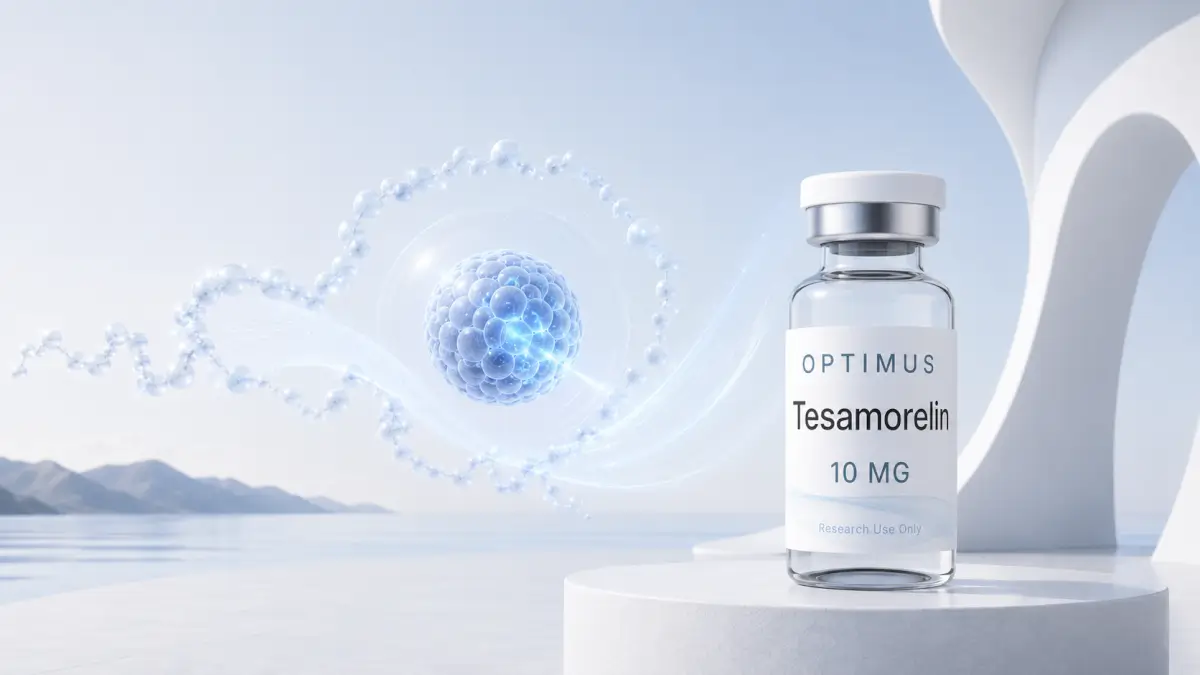
Tesamorelin is a synthetic peptide consisting of 44 amino acids. It is an analogue of Growth Hormone-Releasing Hormone (GHRH) and is supplied as a lyophilised powder for controlled laboratory research investigations.
In scientific literature, Tesamorelin has been examined in experimental studies investigating growth hormone release dynamics, metabolic pathways, and neuroendocrine signalling within defined laboratory models.
How It Works
Tesamorelin acts as a GHRH analogue, binding to the GHRH receptor on pituitary cells. This interaction stimulates the release of growth hormone, which triggers downstream signalling cascades. Its longer half-life compared to native GHRH makes it a compound of interest for studies investigating sustained growth hormone release patterns.
Research Literature on Tesamorelin
The papers cited at the end of this guide belong to the published clinical literature on the GHRH-analogue class rather than to preclinical laboratory work. Falutz and colleagues published two such studies in 2010 and Makimura and colleagues published a further study in 2012; the populations examined and the endpoints measured in each are stated in the references themselves. That body of work concerns investigational clinical use of the analogue class. It is listed here as a bibliographic record only, it has no bearing on material supplied for laboratory research, and nothing reported in it is presented as a property of the compound described on this page.
Reading around an analogue generally means reading about the native molecule alongside it. An analogue is defined by how it differs from the sequence it is derived from, so the literature on a modified releasing hormone tends to be comparative in structure, setting the altered peptide against the native one on properties such as receptor engagement and resistance to enzymatic breakdown. None of the published work referenced here involved material supplied by Optimus Labs.
Tesamorelin Research Applications
Tesamorelin has been referenced in controlled in-vitro and experimental laboratory studies examining:
- Growth hormone release dynamics: Research into GH secretion and regulation
- Metabolic pathways: Investigations into energy balance and metabolism
- Neuroendocrine signalling: Studies on hormonal signalling pathways
- Pituitary cell response: Research on hormone secretion mechanisms
- Receptor binding: Studies on GHRH receptor activation
The headings in that list divide up a field that is more continuous in practice. Pituitary cell response and receptor binding are the same event observed at different scales. The list describes the range of questions the literature has put to this class of peptide rather than separate research programmes.
Tesamorelin Purity and Quality
For reproducible results, confirm the identity and purity of the material before use. The specifications below are a useful checklist.
| Property | Specification |
|---|---|
| Appearance | White lyophilised powder |
| HPLC purity | ≥98% (HPLC-verified) |
| Sequence | 44 amino acids |
| Molecular weight | ~5,135.9 g/mol |
| Storage | -20°C, protected from light and moisture |
| COA | Confirms purity, molecular weight and peptide sequence |
Verifying Purity and Identity
Reversed-phase HPLC and mass spectrometry are the two methods sitting behind a specification sheet. HPLC separates the intended peptide from synthesis-related impurities, and the purity value quoted on a Certificate of Analysis is usually the area percentage of the main peak in that separation. Mass spectrometry then confirms that the measured mass agrees with the mass predicted from the intended sequence. The two are complementary: a chromatogram alone shows how much of one component is present without establishing what it is.
Sequence length is relevant to how much this matters. A longer chain offers more positions at which a synthesis can fail, so deletion and truncation products are a more prominent analytical concern for larger sequences than for short ones. This is also why identity is reported per batch rather than once for a product line. Two batches are not automatically equivalent, and recording the batch number alongside the experimental data is what allows a result to be tied back to the material that produced it.
Reconstitution and Handling
Tesamorelin is supplied as a lyophilised powder and is brought into solution before use. For aqueous preparations, bacteriostatic water is commonly used, as its preservative allows a single vial to serve multiple withdrawals under sterile technique.
Bring the vial and solvent to room temperature, add the solvent gently down the inside wall, and swirl until fully dissolved. Aliquot the reconstituted solution and store frozen (-80°C for longer-term storage) to minimise freeze-thaw cycles.
Storage and Stability
Freeze-drying removes the water that drives most degradation routes, which is why the material is supplied as a dry cake rather than a ready-made solution. Held frozen at the temperature given in the specification table, sealed, and shielded from light, the lyophilised form is the most stable state the peptide occupies. Bring a vial to room temperature before opening it so that moisture does not condense onto cold powder, and close it again promptly afterwards.
Reconstituted material behaves quite differently and has a much shorter working life. The usual practice is to aliquot into single-use volumes at the point of reconstitution, so that no portion of the stock is thawed more than once. Repeated freeze-thaw cycles encourage aggregation and reduce the quantity of intact peptide available to an assay. Each aliquot should carry the compound name, batch number, solvent and date. Where stability over time bears on an experiment, it is measured for that solvent and that assay rather than assumed.
Related Research Compounds
- CJC-1295 (No DAC) — growth hormone research; see our CJC-1295 guide.
- Ipamorelin — growth hormone research; see our Ipamorelin guide.
- IGF-1 LR3 — growth factor research; see our IGF-1 LR3 guide.
- GHRP-6 — growth hormone research; see our GHRP-6 guide.
Tesamorelin in Laboratory Context
The compounds listed above all touch the growth hormone axis, but they meet it at different levels. Tesamorelin and CJC-1295 (No DAC) are both analogues of GHRH and engage the GHRH receptor on pituitary cells. Ipamorelin and GHRP-6 belong to a separate group, the secretagogues acting at the ghrelin receptor. IGF-1 LR3 sits downstream of both, being an analogue of a growth factor rather than a releasing peptide, so work using it does not involve the pituitary step at all.
Because the two upstream groups arrive at the same output through different receptors, they are natural comparators in the literature, and the analogue described here is one of the reference points on the GHRH side of that comparison. The design consequence is that these peptides are not substitutes for one another. An observation made with a GHRH analogue does not automatically describe a ghrelin-receptor secretagogue.
Frequently Asked Questions
What is Tesamorelin used for in research?
Tesamorelin is studied for its role in growth hormone release, metabolic research, and neuroendocrine signalling.
How is Tesamorelin supplied?
Tesamorelin is supplied as a lyophilised powder in sterile vials, ready for reconstitution in research settings.
What purity should I look for?
For most research applications, ≥98% HPLC purity is recommended. Higher purity (≥99%) is preferred for sensitive assays.
What does lyophilised mean?
It means freeze-dried. The peptide is frozen and the water drawn off under vacuum, which leaves a dry cake that is far more stable than the equivalent solution and that redissolves when solvent is added.
How long does reconstituted material stay usable?
There is no single answer, because it depends on the solvent, the storage temperature and how sensitive the assay is to partial degradation. This is why aliquoting and dating every vial matters: it lets a laboratory establish the answer for its own conditions instead of relying on a general figure.
What information does a Certificate of Analysis carry?
It identifies the batch tested, the analytical methods applied, and the results those methods returned, covering purity, molecular weight and peptide sequence. It speaks for that batch rather than for the product line in general.
Why does batch testing matter?
Because separate synthesis and purification runs can differ in their impurity profile. Testing each batch and recording which batch an experiment used keeps that variation visible, which is what makes a result reproducible by someone else later.
For Research at Optimus Labs
Optimus Labs supplies Tesamorelin as a high-purity lyophilised powder, HPLC-verified and batch-tested, with a Certificate of Analysis confirming purity, molecular weight and peptide sequence. Orders ship from the UK with tracked delivery.
Explore the rest of the research catalogue for related laboratory compounds, or our overview of the most popular research peptides in the UK.
References
- Falutz J, et al. (2010). Effects of tesamorelin, a growth hormone-releasing factor, in HIV-infected patients with abdominal fat accumulation. J Acquir Immune Defic Syndr. – https://pubmed.ncbi.nlm.nih.gov/20101189/
- Falutz J, et al. (2010). Effects of tesamorelin (TH9507), a growth hormone-releasing factor analog, in human immunodeficiency virus-infected patients: pooled analysis of two phase 3 trials. J Clin Endocrinol Metab. – https://pubmed.ncbi.nlm.nih.gov/20554713/
- Makimura H, et al. (2012). Metabolic effects of a growth hormone-releasing factor in obese subjects with reduced growth hormone secretion. J Clin Endocrinol Metab. – https://pubmed.ncbi.nlm.nih.gov/23015655/