Thymalin: The Immune System’s Master Trainer

Disclaimer: This content is for laboratory research purposes only. Not for human or animal use.
Table of Contents
Editorial Note
At Optimus Labs, our educational content is developed by reviewing the available scientific literature and aims to provide balanced, evidence-based explanations of peptide research. Unless otherwise stated, the findings discussed in this article are derived primarily from laboratory and animal studies. Research involving humans remains limited for many investigational compounds, and this article should not be interpreted as medical advice or evidence of established clinical efficacy.
What Is Thymalin?
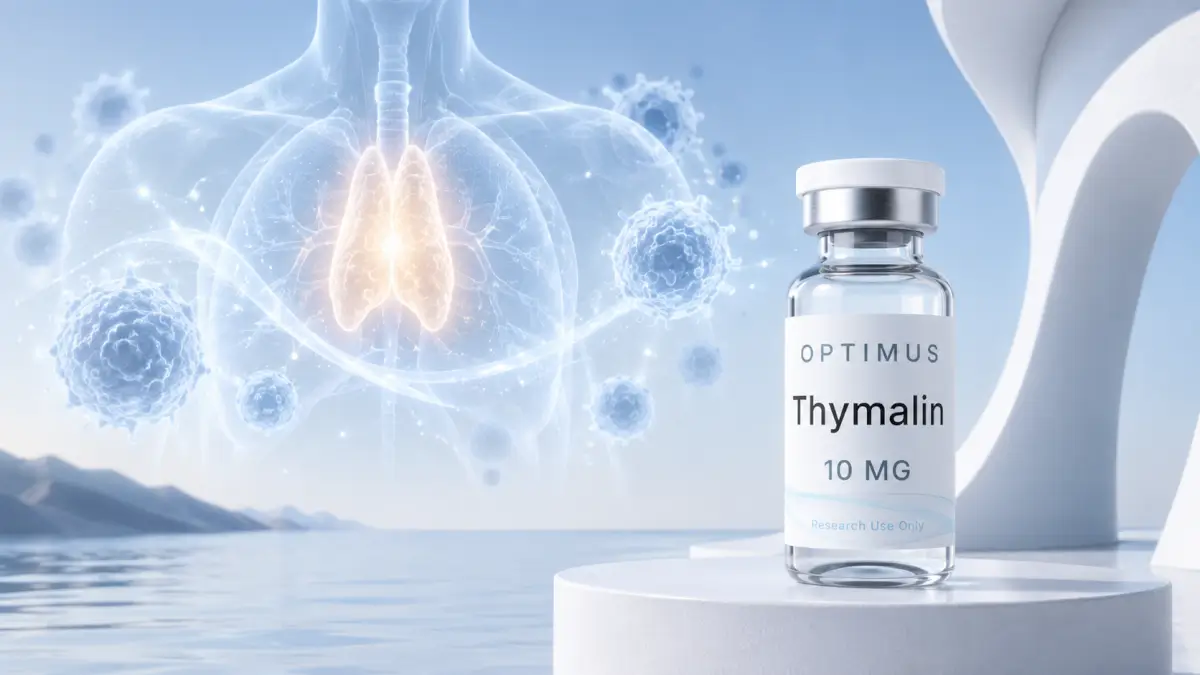
Thymalin is a polypeptide complex derived from the thymus gland — a small organ located in your chest, just behind your breastbone.
Think of the thymus as a military training camp. This is where immune cells — specifically T-cells — go to learn their job. They learn to recognise threats, distinguish friend from foe, and respond appropriately.
Thymalin is not a single, chemically defined compound like some other peptides. It is a polypeptide complex — a mixture of naturally occurring peptide fractions, each studied for its potential role in immune modulation.
Think of Thymalin as the immune system’s master trainer. It doesn’t just send soldiers to the front lines — it makes sure they are properly trained, equipped, and ready to respond when needed.
The Discovery of Thymalin
Thymalin was developed by Professor Vladimir Khavinson and his team at the St. Petersburg Institute of Bioregulation and Gerontology in Russia, starting in the 1970s.
Khavinson pioneered a new approach — using peptide extracts from animal tissues to restore organ function. The first peptide drug created with this technology was Thymalin, isolated from thymus tissue.
Early research produced some interesting findings: Thymalin was studied for its effects on immune function in older models and across various infectious disease models. Over the decades, Khavinson published hundreds of research papers on Thymalin and related peptides, establishing a significant body of evidence that is still being explored today.
Thymalin was approved in Russia in 2010 (registration number LS-000267) and has been used clinically in the former Soviet Union for immunomodulation.
How Thymalin Works
To understand how Thymalin works, you first need to understand the immune system’s soldiers.
T-Cells: The Soldiers
T-cells are the immune cells responsible for recognising and eliminating threats in the body. They patrol the body, looking for anything that doesn’t belong.
Think of T-cells as soldiers. Their job is to identify threats and respond.
Cytokines: The Messengers
Cytokines are signalling molecules that immune cells use to communicate with each other. They coordinate the body’s response to infection, inflammation, and injury.
Think of cytokines as messengers. They carry messages between soldiers, telling them where to go and what to do.
Immunosenescence: The Ageing Army
As we age, our immune system declines — a process called immunosenescence. The soldiers get slower. They don’t recognise threats as quickly. The military becomes less effective.
Thymalin’s Role in Immune Research
Thymalin is like a master trainer, a training manual, and a communication system all in one.
- Active components: The active components in Thymalin are short peptides called EW, KE, and EDP — each contributing to its immune-modulating effects.
- Gene regulation: Research has explored how these short peptides interact with specific DNA sequences and/or histone proteins, and their potential role in regulating genes involved in immune function, inflammation, and cellular ageing.
- T-cell differentiation: Studies have investigated Thymalin’s role in the differentiation of hematopoietic stem cells into mature T-lymphocytes — the soldiers themselves. In one study, Thymalin decreased the expression of CD44 on hematopoietic stem cells 2.8-fold and CD117 2.2-fold, indicating these cells were maturing into functional immune cells.
- Cytokine regulation: Research has explored Thymalin’s influences on cytokines synthesis and its role immune signalling.
- Immunoprotective effects: Studies have reported changes in T and B lymphocyte numbers and ratios, functional activity, and phagocytosis.
Thymalin Research Applications
Immune Function
Thymalin has been studied for its effects on immune function in various contexts, including respiratory infections, chronic inflammatory conditions, and situations where the immune system is compromised.
Ageing and Immunosenescence
As we age, our immune system declines. Thymalin has been studied for its potential to support immune function in older research models.
Respiratory Research
Thymalin has been investigated for its effects in respiratory infection and inflammation models, including acute respiratory syndrome, chronic obstructive bronchitis, and pneumonia of various origins.
Stem Cell Research
Research has explored Thymalin’s role in stem cell differentiation — the process by which stem cells develop into specialised cells, including immune cells.
Thymalin peptides promote hematopoietic stem cell differentiation toward thymocyte lineage in culture, with active dipeptide components EW and KE showing independent activity in directing differentiation.
Research Literature on Thymalin
Four references are given at the end of this guide, and all four come from the St. Petersburg group that developed the complex, which is the shape of the literature as a whole. The most recent, Khavinson and colleagues (2021), is a review of the complex’s use in immunocorrection together with the molecular questions raised by its short peptide components. It is the best single starting point for the gene regulation and cytokine material summarised above.
Khavinson, Linkova, Kvetnoy and colleagues (2020) examined the differentiation of human hematopoietic stem cells in culture in the presence of the complex and of its dipeptide components, which is the study behind the stem cell section. The two older papers, Khavinson and Morozov (2002 and 2003), report the group’s long-term observational work on thymic and pineal peptides in older cohorts. They are listed here because they are the primary sources for the ageing literature; readers should go to the papers themselves for the study designs and the results, which this guide does not restate.
Two things are worth knowing before reading them. Most of the underlying work was published in Russian, and the English-language papers are often summaries of that earlier output. And the material studied was the thymic extract as prepared by the group, so a defined synthetic preparation is not necessarily the same material, a point that matters when a certificate is being compared against the literature. None of the published work described here involved material supplied by Optimus Labs.
Thymalin vs Thymosin Alpha-1: Understanding the Difference
This is one of the most common questions researchers ask.
| Aspect | Thymalin | Thymosin Alpha-1 |
|---|---|---|
| Composition | Polypeptide complex (multiple fractions) | Single, well-defined 28-amino-acid peptide |
| Molecular weight | ~10 kDa (complex) | 3,108 Da |
| Active components | EW, KE, EDP peptides | Single defined peptide |
| Regulatory approval | Russia only | 35+ countries |
| Evidence base | Primarily Russian studies | Extensive international clinical trials |
Key takeaway: Thymosin Alpha-1 is a single, well-defined peptide with extensive international research. Thymalin is a polypeptide complex with a more limited evidence base outside Russia.
For research on immune modulation, Thymosin Alpha-1 offers broader regulatory acceptance and a more defined mechanism of action. For research on longevity and bioregulation, Thymalin offers unique long-term human data not available for other thymic peptides.
What Researchers Should Know
Composition
Thymalin is a polypeptide complex, not a single compound. Its active components include the short peptides EW, KE, and EDP.
Storage
Thymalin should be stored at -20°C, protected from light and moisture. Once reconstituted, aliquot and store at -80°C for long-term stability.
Verifying Purity and Identity
Because the name has been used both for the original thymic extract and for a defined synthetic nonapeptide, the first thing to establish from a Certificate of Analysis is which of the two is in the vial. The technical data on the product page gives the sequence, formula and molecular weight for the supplied material, and the certificate should confirm those values for the batch. A synthetic sequence is verified the way any single peptide is: reversed-phase HPLC for purity, read as the area of the main peak against synthesis-related impurities, and mass spectrometry for identity, checking the observed mass against the mass calculated from the sequence.
A certificate covers the batch that was tested and not the product line, which is why the batch number belongs in the experimental record next to the results it produced. Checking the certificate against the specification table when material arrives settles three things at once: that the compound is what the label states, that it meets the purity threshold the work requires, and that the batch in hand is the one the record will name.
Related Research Compounds
- Thymosin Alpha-1 — immune modulation research; see our Thymosin Alpha-1 guide.
- Epitalon — pineal peptide and ageing research; see our Epitalon guide.
- KPV — inflammation and immune response research; see our KPV guide.
- Selank — neurochemical and immune research; see our Selank guide.
Thymalin in Laboratory Context
The compounds listed above are grouped by the literatures they share rather than by structure. Thymosin Alpha-1 is the natural comparison, since both come from thymus biology, and the table above sets out where they differ. Epitalon belongs beside it for a different reason: the two were developed by the same St. Petersburg group and appear together in its long-term ageing studies, so their literatures are entangled even though one is a pineal peptide and the other thymic.
KPV and Selank sit further away. KPV is a melanocortin-derived tripeptide studied in inflammation models, and Selank appears in neurochemical work that touches immune questions from a different starting point. They appear alongside it because immune research keeps arriving at the same readouts, not because the compounds are alike. For laboratory purposes the useful conclusion is that each needs its own controls, and that a result obtained with one carries no automatic implication for another. Reading the linked guides against one another is a reasonable way to place the complex before a design is settled.
Frequently Asked Questions
What is Thymalin?
Thymalin is a polypeptide complex isolated from the thymus gland, studied for its immunomodulatory properties.
What is the difference between Thymalin and Thymosin Alpha-1?
Thymosin Alpha-1 is a single defined 28-amino-acid peptide approved in 35+ countries. Thymalin is a polypeptide complex with multiple peptide fractions approved only in Russia.
How does Thymalin work?
Thymalin contains short peptides (EW, KE, EDP) that can bind to DNA or histone proteins, regulating gene expression and supporting immune function.
Is Thymalin approved for use?
Thymalin is approved in Russia but not in Western regulatory jurisdictions.
What is Thymalin used for in research?
Thymalin is studied for immune modulation, T-cell differentiation, ageing-related immune decline, and respiratory research.
Is Thymalin a single peptide?
No — Thymalin is a polypeptide complex containing multiple active fractions, including the short peptides EW, KE, and EDP.
How is it supplied?
As a lyophilised powder in a sealed vial, with the sequence, formula and molecular weight of the supplied material given in the technical data on the product page and confirmed on the Certificate of Analysis for the batch.
Is the supplied material an extract or a synthetic peptide?
The material supplied by Optimus Labs is a synthetic peptide made to the sequence shown in the technical data. The historical material studied in the literature was an extract of thymus tissue, which is why this guide describes it as a complex.
What should be checked when the material arrives?
That the label, the batch number and the Certificate of Analysis agree, that the certificate confirms identity as well as purity, and that the vial has been kept sealed, frozen and out of the light until it is needed.
Key Takeaways
- Thymalin is a polypeptide complex from the thymus gland
- It was developed by Professor Vladimir Khavinson in Russia
- Active components include the short peptides EW, KE, and EDP
- It has been studied for immune modulation and T-cell differentiation
- Thymalin is approved in Russia only
- Thymosin Alpha-1 is a different compound — a single defined peptide approved in 35+ countries
- Research on Thymalin is primarily from Eastern European institutions
For Research at Optimus Labs
Optimus Labs supplies Thymalin 10mg and other high-purity research peptides for laboratory use, with Certificates of Analysis confirming purity and identity. Orders ship from the UK with tracked delivery.
Explore the rest of the research catalogue for related laboratory compounds, or our overview of the most popular research peptides in the UK.
References
- Khavinson VKh, et al. (2021). The Use of Thymalin for Immunocorrection and Molecular Aspects of Biological Activity. Biology Bulletin Reviews. – https://link.springer.com/article/10.1134/s2079086421040046
- Khavinson VK, Linkova NS, Kvetnoy IM, et al. (2020). Thymalin: Activation of Differentiation of Human Hematopoietic Stem Cells. Bull Exp Biol Med. – https://pubmed.ncbi.nlm.nih.gov/33237528/
- Khavinson VK, Morozov VG. (2003). Peptides of pineal gland and thymus prolong human life. Neuro Endocrinol Lett. – https://pubmed.ncbi.nlm.nih.gov/14523363/
- Khavinson VK, Morozov VG. (2002). Geroprotective effect of thymalin and epithalamin. Advances in Gerontology. – https://pubmed.ncbi.nlm.nih.gov/12577695/