
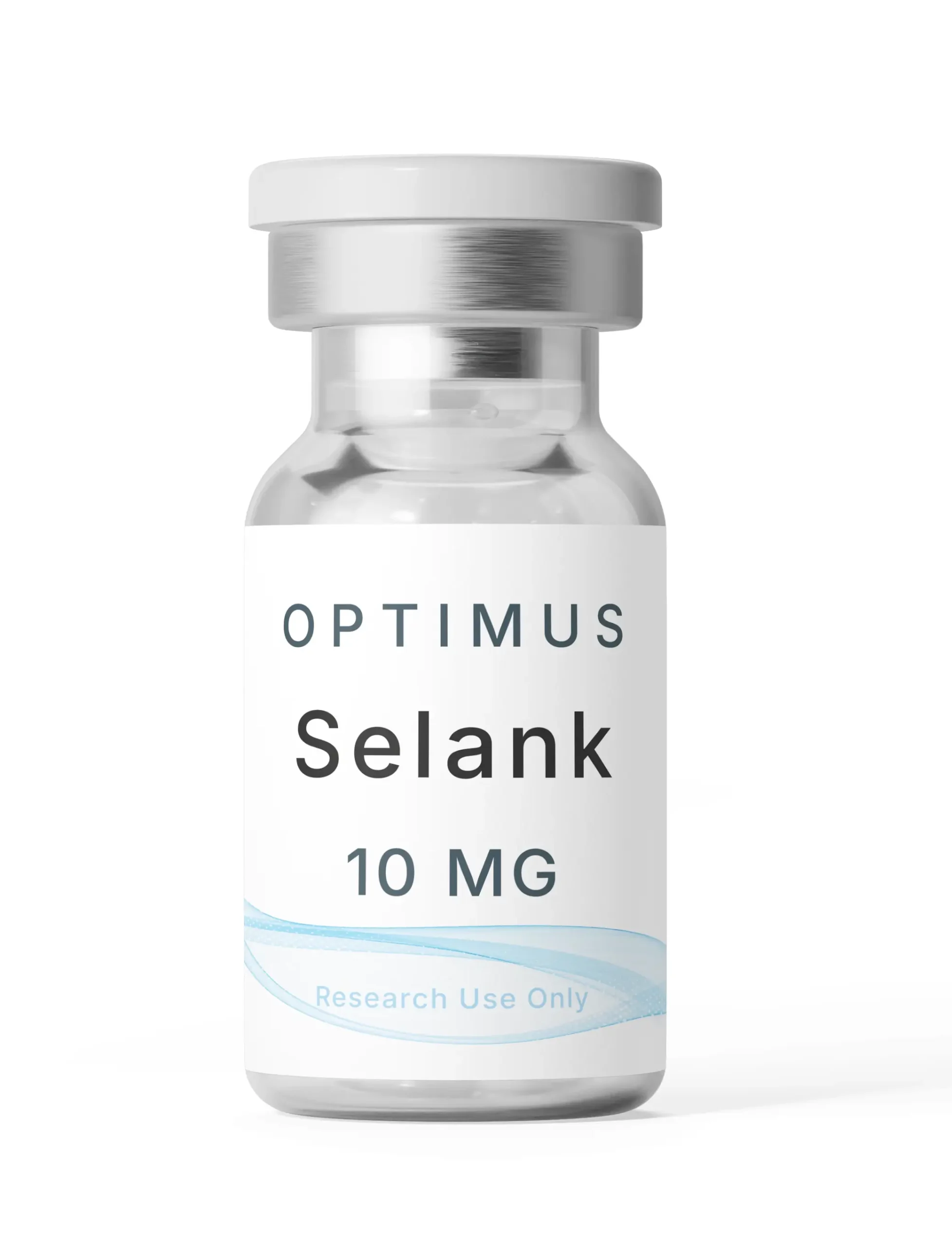



Selank
£14.50
| Quantity | Price | Discount |
|---|---|---|
| 2 | £13.78 | 5% |
| 3-9 | £13.05 | 10% |
| 10+ | £12.33 | 15% |
- Purity: ≥99% (HPLC)
- Batch-controlled manufacturing
- Secure packaging for laboratory handling
- Storage: Store lyophilised powder frozen for long-term stability.
- Following preparation in accordance with laboratory protocols, store solutions refrigerated (2– 8 °C).
- Research use only (not for human or veterinary use)
Get notified when it's back in stock

- Purity: ≥99% (HPLC)
- Batch-controlled manufacturing
- Secure packaging for laboratory handling
- Storage: Store lyophilised powder frozen for long-term stability.
- Following preparation in accordance with laboratory protocols, store solutions refrigerated (2– 8 °C).
- Research use only (not for human or veterinary use)
The nervous and immune systems are in constant communication, exchanging chemical signals that influence countless biological processes throughout the body. Selank has become a recognised laboratory research peptide within this growing field of research, appearing in studies exploring neurochemical signalling, neuroimmunology and peptide biology.
As scientists continue to investigate the molecular pathways that connect neurological and immune function, Selank remains an important subject of experimental laboratory research.
Key Research Areas
- Neurochemical signalling
- Neuroimmunology
- Peptide biology
- Cellular communication
Developed as a synthetic analogue of the naturally occurring peptide tuftsin, Selank has attracted sustained scientific interest because of its unique position at the intersection of neuroscience and immunology.
Rather than being investigated within a single biological pathway, it has featured across multiple areas of laboratory research, including neurotransmitter signalling, peptide-receptor interactions and immune communication. This multidisciplinary research profile has established Selank as a familiar peptide within experimental biology, where researchers continue to investigate how complex signalling networks coordinate normal physiological function.
One of the principal reasons Selank remains an active subject of scientific investigation is its association with neurochemical signalling. The nervous system relies on an intricate network of neurotransmitters and signalling molecules that enable neurons to communicate rapidly and precisely.
Understanding how these communication pathways are regulated remains a major objective of neuroscience, with researchers investigating the molecular mechanisms that coordinate neuronal activity. Experimental studies involving Selank have therefore examined its role within laboratory models exploring these complex signalling systems.
Closely connected to this work is the field of peptide biology. Naturally occurring peptides perform a wide range of regulatory functions throughout the body, acting as molecular messengers that influence communication between cells and tissues.
Because Selank was developed as a synthetic analogue of tuftsin, researchers have explored how its structure may contribute to investigations examining peptide signalling and receptor interactions. This relationship continues to make Selank a recognised compound within laboratory studies focused on molecular communication and peptide function.
Scientific interest in Selank also extends to neuroimmunology. Increasing evidence suggests that the nervous and immune systems operate through highly integrated signalling networks rather than as separate biological systems.
Understanding these interactions has become an important focus of laboratory research, with Selank continuing to feature in experimental studies examining the molecular pathways that connect neurological and immune function.
What makes Selank particularly distinctive is the breadth of scientific questions it helps researchers investigate. Rather than being confined to neuroscience or immunology alone, it has become associated with research spanning molecular signalling, peptide biology, receptor dynamics and cellular communication.
This multidisciplinary research profile continues to make Selank a recognised laboratory research peptide for scientists seeking to better understand the biological systems responsible for communication throughout the body.
This overview introduces Selank as a laboratory research peptide and highlights the scientific areas in which it continues to be investigated.
For researchers wishing to explore the published literature, biological pathways and experimental evidence in greater depth, our dedicated Selank Research Guide provides a comprehensive overview of the peptide and its role within contemporary neuroscience and neuroimmunology research.
Buy Selank in the UK
Selank is supplied as a lyophilised research peptide in 10mg vials, ≥99% purity by HPLC, with the batch Certificate of Analysis available on this page. Orders placed before 2pm, Monday to Friday, are typically dispatched the same working day by Royal Mail Tracked, with free UK delivery on orders over £30. Supplied for laboratory research use only; not for human or veterinary use.
Chemical name: Selank (Thr-Lys-Pro-Arg-Pro-Gly-Pro)
Synonyms: Selank; TP-7; tuftsin analogue (commonly referenced)
Peptide length: 7 amino acids (heptapeptide)
Sequence (1-letter): TKPRPGP
Sequence (3-letter): Thr-Lys-Pro-Arg-Pro-Gly-Pro
Molecular formula: C33H57N11O9
Molecular weight: 751.87 g/mol
CAS: 129954-34-3
Form: Lyophilised (freeze-dried) powder
Appearance: White to off-white solid
For storage and handling of this material, see our guide on how to store peptides.
This product is supplied strictly for laboratory research purposes. It is not intended for human consumption or veterinary use and is not marketed for the diagnosis, treatment, cure, mitigation, or prevention of any disease or medical condition. No directions for personal use are provided or implied. The purchaser is responsible for ensuring compliant handling, storage, and use in accordance with applicable laws and regulations.
Certificate of Analysis for Selank — verifying purity, identity, and quality.
Related Products
CJC-1295 without DAC
Get notified when it's back in stock



Reviews
There are no reviews yet.