What Is KPV? A Research Overview

Disclaimer: This content is for laboratory research purposes only. Not for human or animal use.
Table of Contents
What Is KPV?
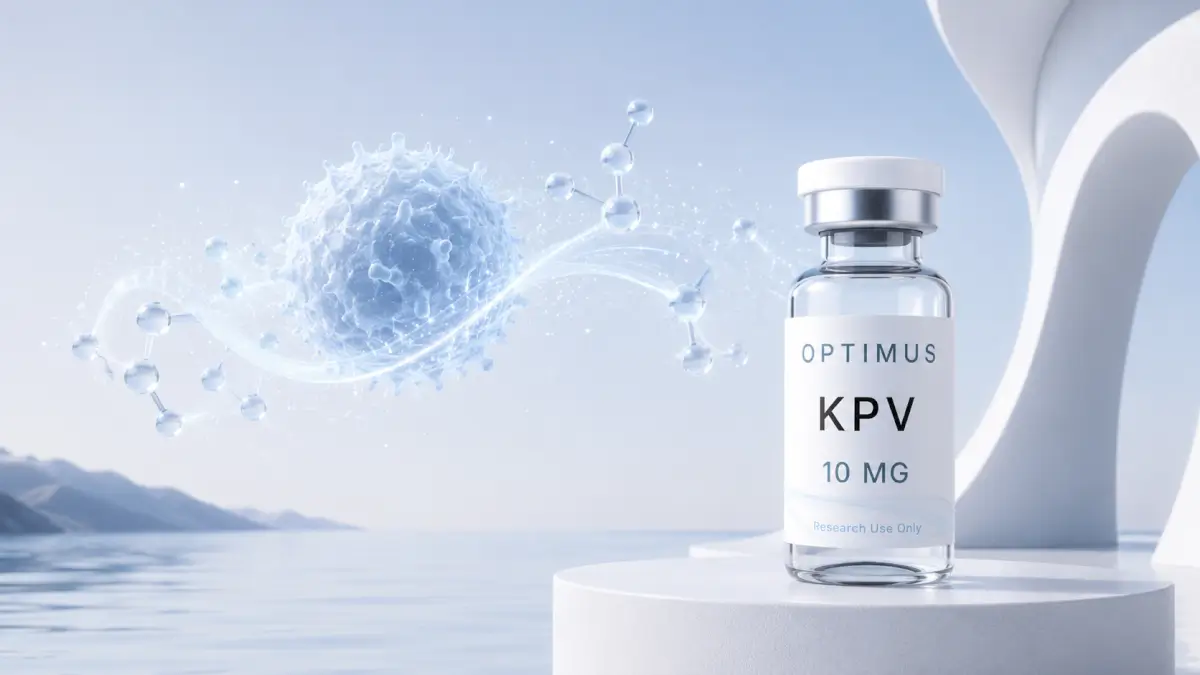
KPV is a synthetic tripeptide consisting of three amino acids with the sequence Lys-Pro-Val. It is a fragment of the naturally occurring peptide alpha-melanocyte-stimulating hormone (α-MSH). KPV is supplied as a lyophilised powder for controlled laboratory research investigations.
In scientific literature, KPV has been examined in experimental studies investigating inflammatory pathways, immune modulation, and cytokine signalling within defined laboratory models.
How It Works
KPV is believed to modulate inflammatory pathways by interacting with melanocortin receptors, which are involved in immune regulation. Research suggests KPV may influence the production of pro-inflammatory and anti-inflammatory cytokines. Its small size and defined structure make it a compound of interest for researchers investigating inflammation and immune response mechanisms.
Research Literature on KPV
Three papers are cited at the end of this guide, and all three work in rodent models of intestinal inflammation. The earliest of them, from Kannengiesser and colleagues (2008), examined the tripeptide in murine models of that kind. The two later papers keep the same class of model but shift the question towards formulation, which is a common direction of travel once a short sequence has been characterised.
Xiao and colleagues (2017) examined an orally targeted delivery system built on functionalised nanoparticles carrying the tripeptide. Sun and colleagues (2021) examined a hydrogel intended to stabilise the peptide, in a rat model. Both are as much about the carrier as about the sequence it holds, and that emphasis is itself informative: for a molecule this short, delivery and stability are the variables an experiment usually has to control first.
These references are given so that the primary sources can be consulted directly, and each paper’s methods section is where the model, the readouts and the conditions are set out. None of the published work described here involved material supplied by Optimus Labs.
KPV Research Applications
KPV has been referenced in controlled in-vitro and experimental laboratory studies examining:
- Inflammatory pathways: Research into cytokine production and signalling
- Immune response modulation: Studies on immune cell activation and regulation
- Cytokine signalling: Investigations into pro-inflammatory and anti-inflammatory mediators
- Neuroinflammatory research: Studies on inflammation in neurological models
- Peptide-receptor interaction dynamics: Research into melanocortin receptor binding
The first three headings overlap heavily, since cytokine measurements are how inflammatory and immune questions are usually operationalised in the first place. The receptor binding entry is the outlier, belonging to a different kind of experiment with different instrumentation. Taken together the list describes the range of questions put to this peptide rather than five self-contained bodies of work.
KPV Purity and Quality
For reproducible results, confirm the identity and purity of the material before use. The specifications below are a useful checklist.
| Property | Specification |
|---|---|
| Appearance | White lyophilised powder |
| HPLC purity | ≥98% (HPLC-verified) |
| Sequence | Lys-Pro-Val |
| Molecular weight | ~370.5 g/mol |
| Storage | -20°C, protected from light and moisture |
| COA | Confirms purity, molecular weight and peptide sequence |
Verifying Purity and Identity
Two analytical methods underpin a specification of this kind, and they answer different questions. Reversed-phase HPLC separates the target peptide from synthesis-related impurities and truncated sequences, and the purity figure on a Certificate of Analysis is normally the area percentage of the main peak in the resulting chromatogram. Mass spectrometry confirms identity rather than purity, checking that the mass observed corresponds to the mass calculated from the intended sequence.
With a sequence this short, identity confirmation carries proportionally more weight. There are few positions at which anything can vary, so a residue in the wrong place produces a molecule that may behave very differently while still looking respectable on a chromatogram. A certificate covers the batch that was tested and not the product line, which is why the batch number belongs in the experimental record next to the results it produced.
Checking the certificate against the specification table when material arrives settles three things at once: that the compound is what the label states, that it meets the purity threshold the work requires, and that the batch in hand is the one the record will name. That is a short task at the point of receipt and an awkward one to reconstruct afterwards.
Reconstitution and Handling
KPV is supplied as a lyophilised powder and is brought into solution before use. For aqueous preparations, sterile water or buffer solutions are commonly used.
Bring the vial and solvent to room temperature, add the solvent gently down the inside wall, and swirl until fully dissolved. Aliquot the reconstituted solution and store frozen (-80°C for longer-term storage) to minimise freeze-thaw cycles.
Storage and Stability
Freeze-drying takes out the water that drives most of the routes by which a peptide degrades, which is why the material is supplied dry rather than pre-dissolved. Sealed in its original vial, frozen at the temperature given in the specification table and kept away from light, the powder holds its specification far better than any solution prepared from it. Moisture is the avoidable problem: let a cold vial reach room temperature before it is opened, and close it again promptly.
Once dissolved, treat the stock as a perishable reagent rather than a stable one. Splitting it into single-use aliquots at the point of reconstitution is the standard precaution, since each freeze-thaw cycle is an opportunity for aggregation and for loss of intact peptide. Label every aliquot with the compound, the batch number, the solvent and the date, and keep the labelling consistent for the duration of a study. How long a solution stays fit for a particular assay is best determined empirically for that assay.
Stability is also the reason two of the papers cited here concern themselves with carriers rather than with the sequence alone. A short peptide is a convenient thing to synthesise and an inconvenient thing to keep intact, and that tension runs through the handling advice above as much as through the published work. Consistent storage is the cheapest way to keep it from becoming an uncontrolled variable.
Related Research Compounds
- Selank — neurochemical and immune research; see our Selank guide.
- Thymosin Alpha-1 — immune modulation research; see our Thymosin Alpha-1 guide.
- NAD+ — cellular energy and ageing research; see our NAD+ guide.
- SS-31 — mitochondrial function research; see our SS-31 guide.
KPV in Laboratory Context
The compounds listed above are grouped by the literatures they appear in rather than by any shared structure, and the differences matter when an experiment is being planned. This tripeptide is a fragment of a larger endogenous peptide and is studied against melanocortin receptors. Thymosin Alpha-1 is a longer sequence with its own immune literature, and Selank appears in neurochemical work that touches immune questions from a different starting point.
NAD+ and SS-31 sit further away still. The first is a coenzyme rather than a peptide, and the second a synthetic sequence directed at the inner mitochondrial membrane. They appear alongside the others because inflammation research and energetics research have been converging on the same tissues, not because the compounds are alike. Nothing here is a substitute for anything else in the list.
For laboratory purposes the useful conclusion is that each of these needs its own controls, and that a result obtained with one carries no automatic implication for another. Reading the linked guides against one another is a reasonable way to place KPV before a design is settled, since it shows plainly which questions have been asked of which compound and where the apparent overlap is only thematic.
Frequently Asked Questions
What is KPV used for in research?
KPV is studied for its role in inflammatory pathways, immune modulation, and cytokine signalling.
How is KPV supplied?
KPV is supplied as a lyophilised powder in sterile vials, ready for reconstitution in research settings.
What purity should I look for?
For most research applications, ≥98% HPLC purity is recommended. Higher purity (≥99%) is preferred for sensitive assays.
What does lyophilised mean?
Lyophilisation is freeze-drying. The peptide is frozen and the water is removed under vacuum, leaving a dry cake that is considerably more stable than the same material in solution and that redissolves when solvent is added.
What should be checked when the material arrives?
Confirm that the vial matches its label, that the appearance agrees with the specification table, and that the Certificate of Analysis refers to the batch actually received. Anything that does not agree is worth resolving before the material is dissolved rather than afterwards.
Why is the batch number worth recording?
Because a Certificate of Analysis describes one batch rather than the product line. Recording the number ties a set of results to the specific material that produced them, which is what makes the work traceable if anyone tries to repeat it later.
How long can a reconstituted solution be kept?
That depends on the solvent, the storage conditions and how tolerant the assay is of partial loss, so it is a question the laboratory answers from its own data. Preparing single-use aliquots and recording the reconstitution date is what makes it answerable at all.
For Research at Optimus Labs
Optimus Labs supplies KPV as a high-purity lyophilised powder, HPLC-verified and batch-tested, with a Certificate of Analysis confirming purity, molecular weight and peptide sequence. Orders ship from the UK with tracked delivery.
Explore the rest of the research catalogue for related laboratory compounds, or our overview of the most popular research peptides in the UK.
References
- Kannengiesser K, et al. (2008). Melanocortin-derived tripeptide KPV has anti-inflammatory potential in murine models of inflammatory bowel disease. Inflamm Bowel Dis. – https://pubmed.ncbi.nlm.nih.gov/18092346/
- Xiao B, et al. (2017). Orally Targeted Delivery of Tripeptide KPV via Hyaluronic Acid-Functionalized Nanoparticles Efficiently Alleviates Ulcerative Colitis. Mol Ther. – https://pubmed.ncbi.nlm.nih.gov/28143741/
- Sun J, et al. (2021). Self-Cross-Linked Hydrogel of Cysteamine-Grafted γ-Polyglutamic Acid Stabilized Tripeptide KPV for Alleviating TNBS-Induced Ulcerative Colitis in Rats. ACS Biomater Sci Eng. – https://pubmed.ncbi.nlm.nih.gov/34547895/