What Is Ipamorelin? A Research Overview

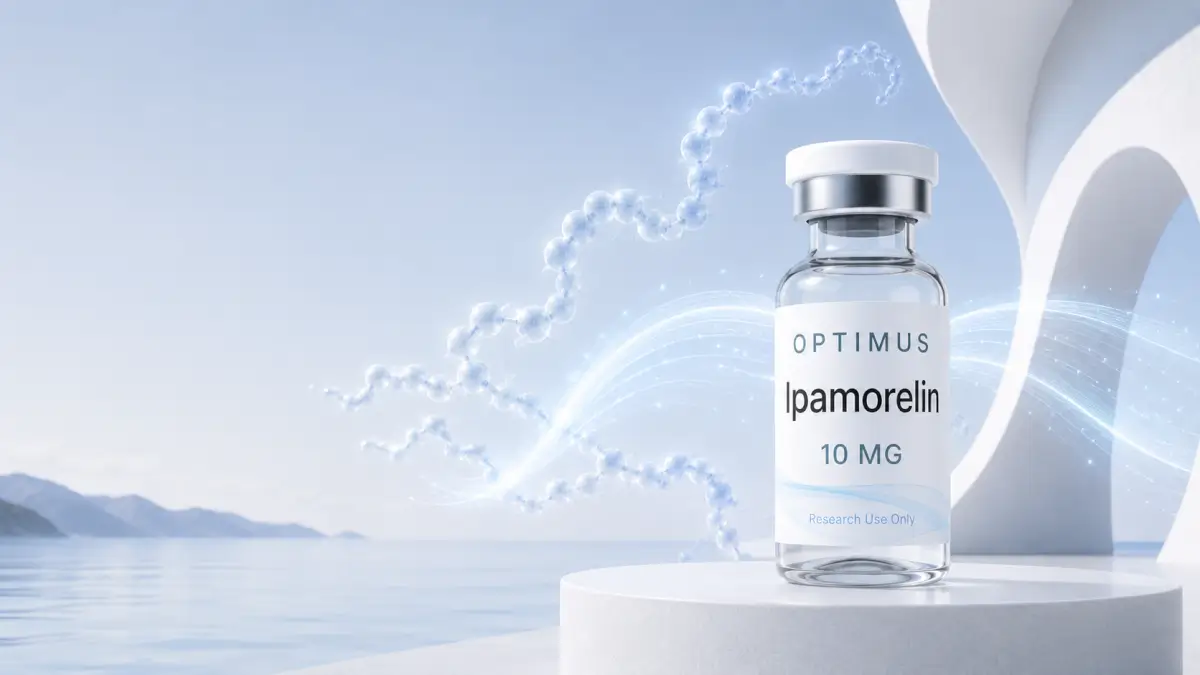
Disclaimer: This content is for laboratory research purposes only. Not for human or animal use.
Table of Contents
What Is Ipamorelin?
Ipamorelin is a synthetic peptide consisting of five amino acids with the sequence Aib-His-D-2-Nal-D-Phe-Lys-NH₂. It is a growth hormone secretagogue (GHS) that stimulates the release of growth hormone in a dose-dependent manner. Ipamorelin is supplied as a lyophilised powder for controlled laboratory research investigations.
In scientific literature, Ipamorelin has been examined in experimental studies investigating growth hormone release mechanisms, metabolic pathways, and receptor selectivity within defined laboratory models.
How It Works
Ipamorelin acts as a selective agonist at the ghrelin receptor (GHS-R1a). Unlike other growth hormone secretagogues, it is known for its receptor selectivity, which minimises off-target endocrine effects. Research suggests Ipamorelin stimulates growth hormone release without significantly affecting cortisol or prolactin levels, making it a compound of interest for studies investigating specific GH release pathways.
Research Literature on Ipamorelin
Three papers are cited at the end of this guide, and each approaches the compound from a different direction. Raun and colleagues (1998) reported the characterisation of the peptide as a selective growth hormone secretagogue. Work of that kind establishes how a compound behaves in defined assay conditions.
Venkova and colleagues (2009) examined the peptide as a ghrelin mimetic in a rodent model of postoperative ileus. That study belongs to the animal-model literature rather than to receptor-assay work, and it illustrates that secretagogue research has not been confined to measurements of hormone release alone. Ferro and colleagues (2017) took a broader view again, examining structure-activity relationships across peptidic growth hormone secretagogues as a class and comparing how structural differences between related peptides relate to activity.
These references are listed so that readers can consult the primary sources directly. None of the published work described here involved material supplied by Optimus Labs.
Ipamorelin Research Applications
Ipamorelin has been referenced in controlled in-vitro and experimental laboratory studies examining:
- Growth hormone release dynamics: Research into GH secretion and regulation
- Ghrelin receptor binding: Studies on receptor selectivity and activation
- Metabolic pathways: Investigations into energy balance and metabolism
- Receptor selectivity assays: Research on targeted receptor activation
- Endocrine signalling: Studies on hormonal signalling pathways
These categories overlap more than a list format suggests. A receptor selectivity assay and an investigation into growth hormone release dynamics may use the same preparation and differ only in what is measured. The list is best read as the range of questions the literature has put to this compound rather than as separate research programmes.
Ipamorelin Purity and Quality
For reproducible results, confirm the identity and purity of the material before use. The specifications below are a useful checklist.
| Property | Specification |
|---|---|
| Appearance | White lyophilised powder |
| HPLC purity | ≥98% (HPLC-verified) |
| Sequence | Aib-His-D-2-Nal-D-Phe-Lys-NH₂ |
| Molecular weight | ~711.9 g/mol |
| Storage | -20°C, protected from light and moisture |
| COA | Confirms purity, molecular weight and peptide sequence |
Verifying Purity and Identity
Two analytical methods do most of the work behind a specification like the one above. Reversed-phase HPLC separates the target peptide from synthesis-related impurities and truncated sequences, and the purity figure quoted on a Certificate of Analysis is normally the area percentage of the main peak in that chromatogram. Mass spectrometry answers a different question, confirming that the observed mass corresponds to the mass calculated from the intended sequence. That is what distinguishes the correct peptide from a closely related one eluting at a similar time.
A Certificate of Analysis applies to a batch, not to a product line. It records which batch was tested, which methods were used, and what they returned. This is why batch testing matters for reproducibility: two batches of the same compound are not automatically identical, and an experiment that cannot be traced back to a particular batch is harder for anyone else to repeat. Keeping the certificate with the experimental record and quoting the batch number in any write-up removes a category of later ambiguity.
Reconstitution and Handling
Ipamorelin is supplied as a lyophilised powder and is brought into solution before use. For aqueous preparations, bacteriostatic water is commonly used, as its preservative allows a single vial to serve multiple withdrawals under sterile technique.
Bring the vial and solvent to room temperature, add the solvent gently down the inside wall, and swirl until fully dissolved. Aliquot the reconstituted solution and store frozen (-80°C for longer-term storage) to minimise freeze-thaw cycles.
Storage and Stability
Peptides are considerably more stable in the lyophilised state than in solution, which is the reason the material is supplied as a dry powder rather than pre-dissolved. The freeze-dried cake should be kept in the frozen conditions given in the specification table, in its original sealed vial, and away from light. Moisture is the other consideration. Allowing a cold vial to reach room temperature before opening reduces condensation, and resealing promptly limits uptake of atmospheric water.
Once in solution the picture changes and the material should be treated as a perishable reagent. Dividing the solution into single-use aliquots at the point of reconstitution is the standard way to avoid repeated freeze-thaw cycles, since each cycle is an opportunity for aggregation and for loss of intact peptide. Label every aliquot with the compound, the batch number, the solvent and the date. How long a solution remains fit for a given assay is best settled empirically.
Related Research Compounds
- CJC-1295 (No DAC) — growth hormone research; see our CJC-1295 guide.
- Tesamorelin — growth hormone research; see our Tesamorelin guide.
- IGF-1 LR3 — growth factor research; see our IGF-1 LR3 guide.
- GHRP-6 — growth hormone research; see our GHRP-6 guide.
Ipamorelin in Laboratory Context
The compounds listed above are grouped together because they all intersect with the growth hormone axis, but they meet it at different points, and the distinction matters when a study is being designed. GHRH analogues such as Tesamorelin and CJC-1295 (No DAC) act at the GHRH receptor on pituitary cells. This peptide and GHRP-6 are secretagogues that act at the ghrelin receptor instead. IGF-1 LR3 sits further downstream again, as an analogue of a growth factor rather than a releasing peptide, and so does not involve the pituitary step at all.
Within the ghrelin-receptor group the recurring question in the literature has been selectivity, which is the angle Ferro and colleagues approached structurally. The practical consequence for a laboratory is that these compounds are not interchangeable in an experimental design. Results obtained with one member of the class should not be assumed to carry across to another.
Frequently Asked Questions
What is Ipamorelin used for in research?
Ipamorelin is studied for its role in growth hormone release, ghrelin receptor binding, and metabolic research.
How is Ipamorelin supplied?
Ipamorelin is supplied as a lyophilised powder in sterile vials, ready for reconstitution in research settings.
What purity should I look for?
For most research applications, ≥98% HPLC purity is recommended. Higher purity (≥99%) is preferred for sensitive assays.
What does lyophilised mean?
Lyophilisation is freeze-drying. The peptide is frozen and the water removed under vacuum, leaving a dry cake that is far more stable than the same material in solution and that dissolves again when solvent is added.
Why does the purity threshold matter for reproducibility?
Whatever is not the target peptide is something else, usually synthesis-related impurities or truncated sequences. If that fraction varies between batches then a variable has been introduced that the experimental design does not account for, and results become harder to compare across runs.
What does a Certificate of Analysis confirm?
It states the batch tested, the analytical methods applied, and the results returned for that batch, including purity, molecular weight and peptide sequence. It describes that batch specifically rather than the product line as a whole.
Which solvent should be used for reconstitution?
Solvent choice depends on the assay and on what the downstream analysis will tolerate, so it is decided by the laboratory rather than dictated here. Whichever is chosen, keeping it consistent between runs removes one source of variation when results are compared.
For Research at Optimus Labs
Optimus Labs supplies Ipamorelin as a high-purity lyophilised powder, HPLC-verified and batch-tested, with a Certificate of Analysis confirming purity, molecular weight and peptide sequence. Orders ship from the UK with tracked delivery.
Explore the rest of the research catalogue for related laboratory compounds, or our overview of the most popular research peptides in the UK.
References
- Raun K, et al. (1998). Ipamorelin, the first selective growth hormone secretagogue. Eur J Endocrinol. – https://pubmed.ncbi.nlm.nih.gov/9849822/
- Venkova K, et al. (2009). Efficacy of ipamorelin, a novel ghrelin mimetic, in a rodent model of postoperative ileus. J Pharmacol Exp Ther. – https://pubmed.ncbi.nlm.nih.gov/19289567/
- Ferro P, et al. (2017). Structure-activity relationship for peptidic growth hormone secretagogues. Drug Test Anal. – https://pubmed.ncbi.nlm.nih.gov/26811125/