What Is IGF-1 LR3? A Research Overview

Disclaimer: This content is for laboratory research purposes only. Not for human or animal use.
Table of Contents
What Is IGF-1 LR3?
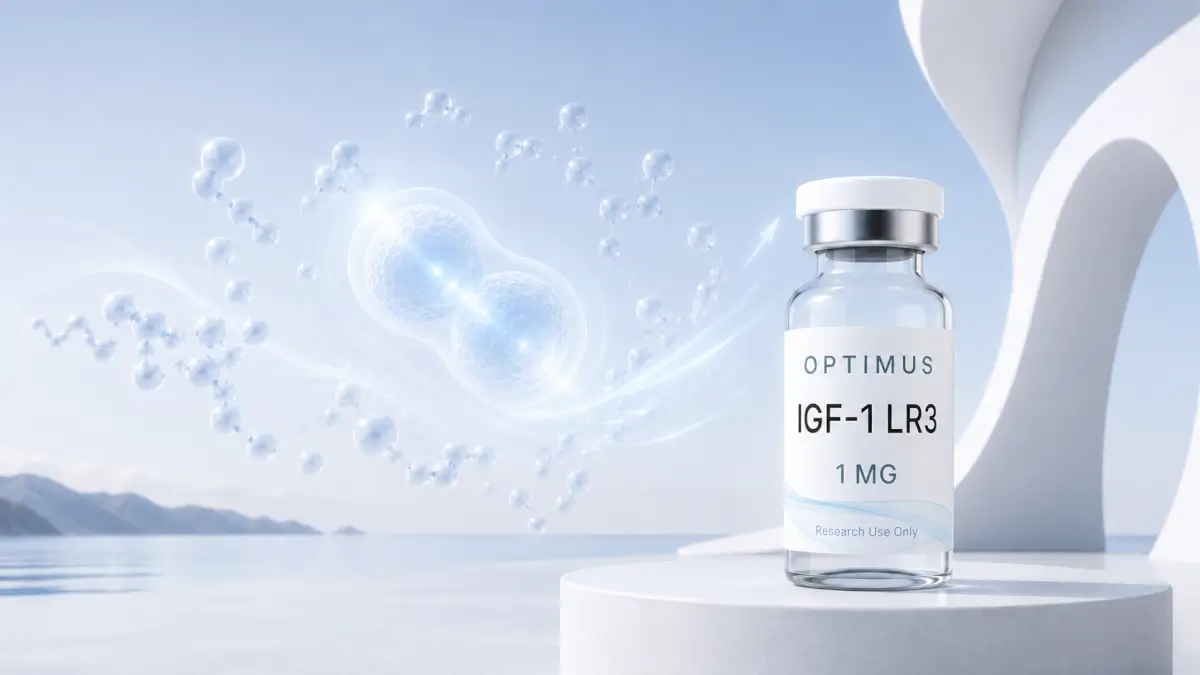
IGF-1 LR3 (Long R3 Insulin-like Growth Factor-1) is a synthetic analogue of insulin-like growth factor-1. It consists of 83 amino acids and is a potent growth factor that promotes cellular proliferation and differentiation. IGF-1 LR3 is supplied as a lyophilised powder for controlled laboratory research investigations.
In scientific literature, IGF-1 LR3 has been examined in experimental studies investigating cellular growth, proliferation, and metabolic pathways within defined laboratory models.
How It Works
IGF-1 LR3 acts as a potent agonist at the IGF-1 receptor, promoting cellular proliferation and differentiation. Unlike native IGF-1, LR3 has reduced binding affinity to IGF-binding proteins, which increases its bioavailability and potency in certain research models. This makes it a compound of interest for studies investigating growth factor signalling pathways.
Research Literature on IGF-1 LR3
The three papers cited at the end of this guide trace a path from making the material to using it in defined models. King and colleagues (1992) reported the production and characterisation of recombinant IGF-I together with potent analogues of it. Papers of that kind answer the prior question that comparative work depends on, namely what the material is and how it can be produced consistently enough to study.
Tomas and colleagues (1993) examined IGF-I and more potent variants of it in a diabetic rat model. Tomas (2001) examined the LR3 analogue specifically, in rodents under food restriction. Both belong to the animal-model literature rather than to cell-culture work, and both are comparative in design, setting the modified molecule against the native one under a defined physiological condition. Readers should consult the primary sources for what each measured and reported.
These references are listed so that the original papers can be located directly. None of the published work described here involved material supplied by Optimus Labs.
IGF-1 LR3 Research Applications
IGF-1 LR3 has been referenced in controlled in-vitro and experimental laboratory studies examining:
- Cellular proliferation: Research into cell growth and division
- Growth factor signalling: Studies on IGF-1 receptor activation
- Metabolic research: Investigations into metabolic pathways
- Receptor binding dynamics: Research on binding affinity and specificity
- Cell culture models: Studies on cell growth and differentiation
Those categories describe one continuous line of enquiry rather than five separate ones. A cell culture model is usually the setting in which proliferation is measured, and receptor binding dynamics are what a signalling question resolves into once it is made experimentally specific. The list is best read as the range of questions the literature has put to this growth factor analogue.
IGF-1 LR3 Purity and Quality
For reproducible results, confirm the identity and purity of the material before use. The specifications below are a useful checklist.
| Property | Specification |
|---|---|
| Appearance | White lyophilised powder |
| HPLC purity | ≥98% (HPLC-verified) |
| Sequence | 83 amino acids |
| Molecular weight | ~9,100 g/mol |
| Storage | -20°C, protected from light and moisture |
| COA | Confirms purity, molecular weight and peptide sequence |
Verifying Purity and Identity
A specification sheet rests on two analytical methods. Reversed-phase HPLC separates the intended molecule from process-related impurities and closely similar species, and the purity figure on a Certificate of Analysis is normally the area percentage of the main peak in that separation. Mass spectrometry then checks that the observed mass matches the mass calculated from the intended sequence. Each answers half the question: the chromatogram reports how much of the principal component is present, and the mass confirms what that component is.
Molecules of this size introduce a further consideration. A chain of this length adopts a folded structure, and neither peak area nor mass reports directly on whether that structure is intact, which is why handling that avoids denaturing conditions matters as much as the certificate does. It is also why testing is reported per batch. Separate production and purification runs are not automatically equivalent, and recording the batch number with the experimental data is what lets a result be traced to the material behind it.
Reconstitution and Handling
IGF-1 LR3 is supplied as a lyophilised powder and is brought into solution before use. For aqueous preparations, sterile water or buffer solutions are commonly used.
Bring the vial and solvent to room temperature, add the solvent gently down the inside wall, and swirl until fully dissolved. Aliquot the reconstituted solution and store frozen (-80°C for longer-term storage) to minimise freeze-thaw cycles.
Storage and Stability
Water drives most of the routes by which a protein preparation degrades, and freeze-drying removes it, which is why the material arrives as a dry cake rather than a solution. Kept sealed, frozen at the temperature stated in the specification table, and shielded from light, the lyophilised form is the most stable state the material occupies. Let a vial reach room temperature before opening it, so that moisture does not condense onto cold powder, and reseal it promptly.
In solution the material should be treated as a perishable reagent. Aliquot it into single-use volumes at the point of reconstitution so that no part of the stock is thawed more than once, since repeated freeze-thaw cycles promote aggregation and reduce the amount of intact material available. Larger molecules are also worth protecting from vigorous agitation, which is why gentle swirling rather than shaking is the usual instruction. Label each aliquot with the compound, batch number, solvent and date.
Related Research Compounds
- CJC-1295 (No DAC) — growth hormone research; see our CJC-1295 guide.
- Ipamorelin — growth hormone research; see our Ipamorelin guide.
- Tesamorelin — growth hormone research; see our Tesamorelin guide.
- GHRP-6 — growth hormone research; see our GHRP-6 guide.
IGF-1 LR3 in Laboratory Context
The compounds listed above are grouped by their common relation to the growth hormone axis, but this one occupies a different position in it from the others. CJC-1295 (No DAC) and Tesamorelin are GHRH analogues acting at the pituitary, and Ipamorelin and GHRP-6 are secretagogues acting at the ghrelin receptor. All four are upstream compounds whose effects in a model depend on an intact releasing pathway. The analogue described here acts at the growth factor receptor itself, which places it downstream of that pathway.
That distinction has a practical consequence for experimental design. A study using an upstream compound is observing a chain of events with several steps in it, whereas one using a downstream growth factor analogue is observing fewer. The two designs answer different questions, and results are not transferable between them.
Frequently Asked Questions
What is IGF-1 LR3 used for in research?
IGF-1 LR3 is studied for its role in cellular proliferation, growth factor signalling, and metabolic research.
How is IGF-1 LR3 supplied?
IGF-1 LR3 is supplied as a lyophilised powder in sterile vials, ready for reconstitution in research settings.
What purity should I look for?
For most research applications, ≥98% HPLC purity is recommended. Higher purity (≥99%) is preferred for sensitive assays.
What does lyophilised mean?
Lyophilisation is freeze-drying. The material is frozen and the water removed under vacuum, leaving a dry cake that is considerably more stable than the same material in solution and that goes back into solution when solvent is added.
How should the material be handled to avoid degradation?
Keep it frozen and sealed in the dark until it is needed, warm the vial before opening it, dissolve it gently rather than by shaking, and split the solution into single-use aliquots so that nothing is thawed repeatedly. Most avoidable losses come from heat, moisture, agitation and repeated freeze-thaw cycles.
What does a Certificate of Analysis confirm?
It names the batch tested, the analytical methods used, and the results returned for purity, molecular weight and peptide sequence. It applies to that batch rather than to the product line as a whole.
Why does the purity threshold matter for reproducibility?
Whatever is not the target molecule is something else, and if that fraction varies between batches an uncontrolled variable has entered the experiment. Working to a stated threshold and recording the batch keeps comparisons between runs meaningful.
For Research at Optimus Labs
Optimus Labs supplies IGF-1 LR3 as a high-purity lyophilised powder, HPLC-verified and batch-tested, with a Certificate of Analysis confirming purity, molecular weight and peptide sequence. Orders ship from the UK with tracked delivery.
Explore the rest of the research catalogue for related laboratory compounds, or our overview of the most popular research peptides in the UK.
References
- King R, et al. (1992). Production and characterization of recombinant insulin-like growth factor-I (IGF-I) and potent analogues of IGF-I. J Mol Endocrinol. – https://pubmed.ncbi.nlm.nih.gov/1311930/
- Tomas FM, et al. (1993). Insulin-like growth factor-I and more potent variants restore growth of diabetic rats without inducing all characteristic insulin effects. Biochem J. – https://pubmed.ncbi.nlm.nih.gov/7683875/
- Tomas FM. (2001). Insulin-like growth factor-I (IGF-I) analogue, LR(3)IGF-I, ameliorates the loss of body weight but not skeletal muscle during food restriction. Growth Horm IGF Res. – https://pubmed.ncbi.nlm.nih.gov/11472075/