What Is TB-500? A Complete Research Overview

This content is for laboratory research purposes only. Not for human or animal use.
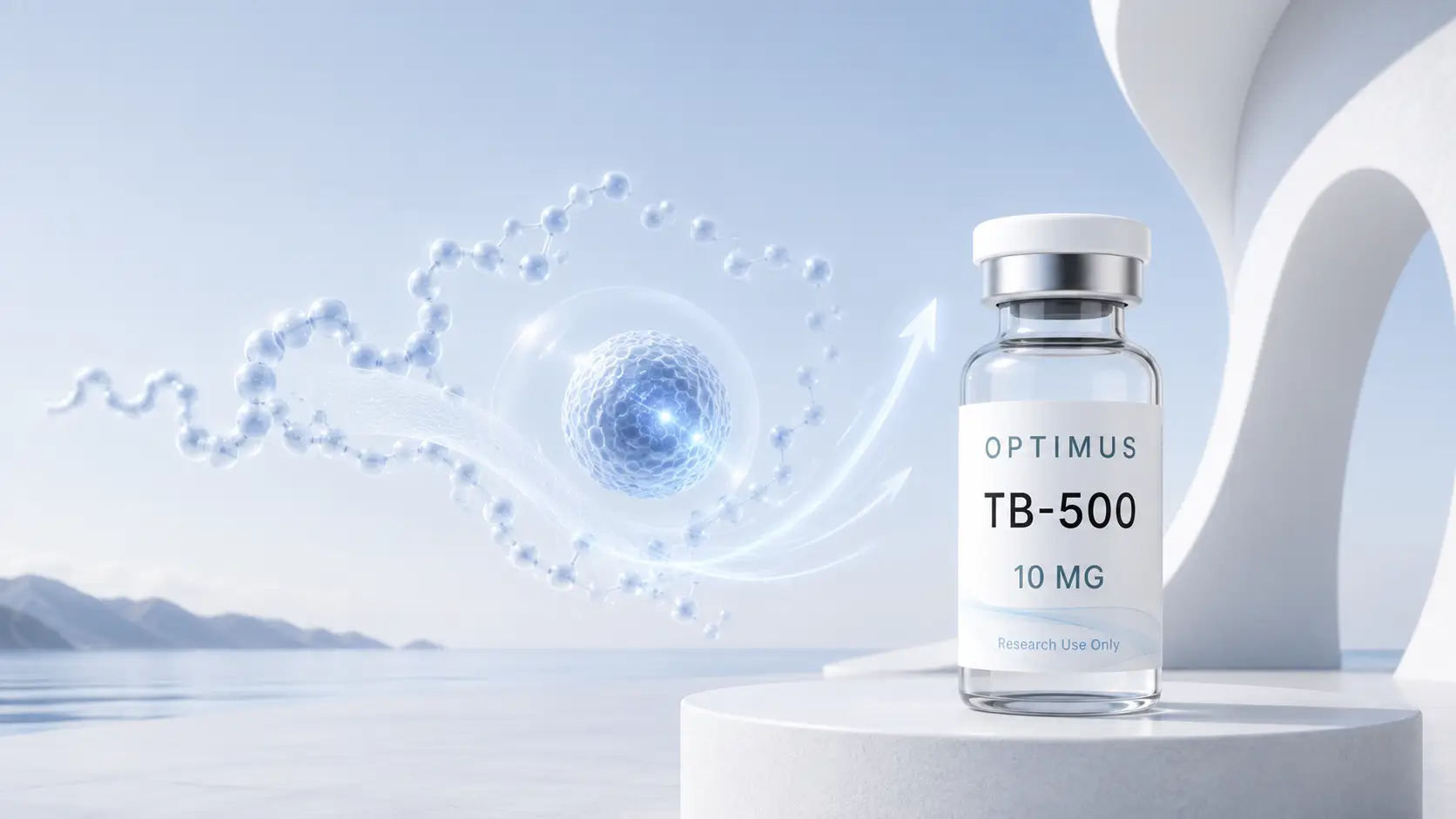
TB-500 is a synthetic peptide corresponding to a fragment of Thymosin Beta-4, a naturally occurring protein found in all cells. Studied in the laboratory for its role in cell migration, angiogenesis and tissue-repair models, it is best known for binding actin. This guide explains what the peptide is, how it works, what it is used for in research, and the purity and storage points that matter when working with it.
Table of Contents
What Is TB-500?
It is a synthetic peptide that corresponds to an active fragment of Thymosin Beta-4 (Tβ4), a protein present in nearly all cell types. The parent protein is 43 amino acids long and is central to how cells build and remodel their internal scaffolding. The defining property of the fragment is that it binds actin — a structural protein involved in cell shape and movement — which is what makes it a useful tool for studying cell migration and tissue repair in vitro.
Because actin dynamics underpin so many cellular processes, a soluble, well-characterised Thymosin Beta-4 fragment gives researchers a defined way to probe migration, wound-repair and angiogenesis pathways in controlled experiments.
How It Works
The peptide is studied through several connected mechanisms in laboratory models:
- Actin binding: it binds actin, influencing the cytoskeletal reorganisation that drives cell migration and tissue repair.
- Cell migration: research indicates it may promote the movement of cells toward sites of injury in model systems.
- Angiogenesis: studies suggest it may support the formation of new blood vessels, a key step in tissue regeneration.
The value of a defined peptide here is control: adding a known amount to a defined system lets researchers attribute an observed change to the fragment rather than to a broader manipulation.
TB-500 Research Applications
Wound-healing studies
Research has reported that the peptide may promote the migration of cells to sites of injury, supporting wound-repair processes in model systems and, in some studies, accelerating the closure of experimental skin and soft-tissue wounds.
Angiogenesis research
It has been studied for its potential to stimulate angiogenesis, making it a compound of interest for researchers investigating vascular repair and tissue regeneration.
Actin regulation
Because the fragment binds actin, it is used to probe how cytoskeletal dynamics influence cell structure, movement and repair in cell-based assays.
TB-500 Purity and Quality
For reproducible results, confirm the identity and purity of the material before use. The specifications below are a useful checklist.
| Property | Specification |
|---|---|
| Appearance | White lyophilised powder |
| HPLC purity | ≥98% (HPLC-verified) |
| Molecular weight | ~4,964.4 g/mol |
| Storage | -20°C, protected from light and moisture |
| COA | Confirms purity, molecular weight and peptide sequence |
Impurities and truncated sequences can confound an assay, so a batch Certificate of Analysis confirming sequence and HPLC purity is essential. See why peptide purity matters for more on why this underpins reliable research data.
Reconstitution and Handling
The peptide is supplied as a lyophilised powder and is brought into solution before use. For aqueous preparations, bacteriostatic water is commonly used, as its preservative allows a single vial to serve multiple withdrawals under sterile technique. Bring the vial and solvent to room temperature, add the solvent gently down the inside wall, and swirl until fully dissolved. Aliquot the reconstituted solution and store frozen (-80°C for longer-term storage) to minimise freeze-thaw cycles.
TB-500 vs BPC-157: What’s the Difference?
TB-500 and BPC-157 are often studied together because their proposed mechanisms are complementary, but they are distinct compounds.
| TB-500 | BPC-157 | |
|---|---|---|
| Research focus | Wound healing, cell migration, actin regulation | Tissue repair, angiogenesis, inflammatory pathways |
| Molecular weight | ~4,964.4 g/mol | ~1,419.6 g/mol |
| Proposed mechanism | Actin binding + angiogenesis stimulation | VEGF modulation + growth-factor activation |
Because the two act through different routes, researchers frequently investigate them side by side in tissue-repair models.
Related Research Compounds
- BPC-157 — tissue-repair and angiogenesis models (often studied alongside it); see our BPC-157 guide.
- GHK-Cu — collagen synthesis and tissue-remodelling research; see our GHK-Cu guide.
- KPV — inflammation and immune-response studies.
- NAD+ — cellular energy and ageing research.
- SS-31 — mitochondrial-function studies.
Frequently Asked Questions
What is TB-500 used for in research?
It is studied for its potential role in wound healing, angiogenesis, tissue repair and cell migration in laboratory models.
How is it supplied?
Typically as a white lyophilised (freeze-dried) powder in a sealed vial, ready for reconstitution in a research setting.
What purity should I look for?
For most applications, ≥98% HPLC purity is recommended; ≥99% is preferred for sensitive assays, confirmed by a batch Certificate of Analysis.
How should it be stored?
Store the powder at -20°C, protected from light and moisture. Once reconstituted, aliquot and store at -80°C for long-term storage.
What is the molecular weight of TB-500?
Approximately 4,964.4 g/mol; confirm the exact figure on the COA, as it can vary by form.
For Research at Optimus Labs
Optimus Labs supplies TB-500 as a high-purity lyophilised powder, HPLC-verified and batch-tested, with a Certificate of Analysis confirming purity, molecular weight and peptide sequence. Orders ship from the UK with tracked delivery. Explore the rest of the research catalogue for related laboratory compounds, or our overview of the most popular research peptides in the UK.
References
- Malinda KM, et al. (1999). Thymosin beta4 accelerates wound healing. J Invest Dermatol — pubmed.ncbi.nlm.nih.gov
- Kim S, et al. (2014). Thymosin beta 4 improves dermal burn wound healing. Biochim Biophys Acta — pubmed.ncbi.nlm.nih.gov
- Rahaman KA, et al. (2024). Simultaneous quantification of TB-500 and its metabolites in in-vitro experiments. J Chromatogr B — pubmed.ncbi.nlm.nih.gov