What Is GHK-Cu? A Complete Guide to Copper Tripeptide-1

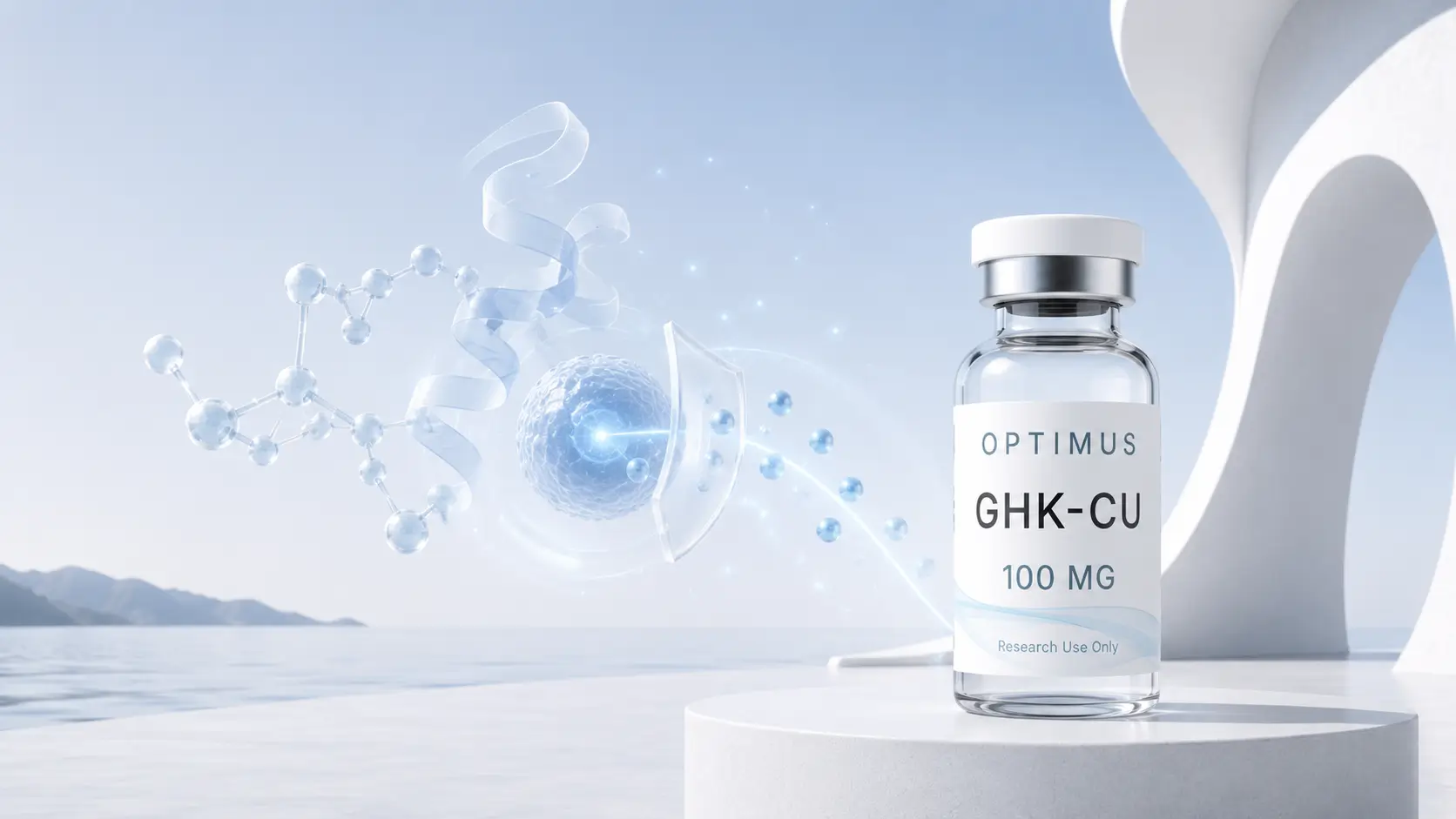
This content is for laboratory research purposes only. Not for human or animal use.
GHK-Cu (Copper Tripeptide-1) is a naturally occurring copper complex first identified in human plasma in 1973. This guide explains what the copper tripeptide is, the “copper drop” that comes with age, how it is studied in the laboratory, and the purity and storage points that matter when working with it.
Table of Contents
What Is GHK-Cu?
GHK-Cu — also called Copper Tripeptide-1 or simply copper peptide — is a naturally occurring copper complex composed of three amino acids (glycine, histidine and lysine) bound to a single copper ion. First isolated from human plasma in 1973, the tripeptide is notable for its ability to carry copper, a metal that serves as a cofactor for numerous enzymatic reactions in biological systems.
In laboratory research, the tripeptide has been studied across a range of cellular processes, including tissue-repair models, collagen synthesis and antioxidant activity. Its defining feature is the copper-binding tripeptide structure: the metal is held in a stable coordination complex that can be delivered to cells, which is what makes it an interesting tool for in vitro work.
The “Copper Drop” Theory
Research has documented a correlation between age and the natural level of the tripeptide in the body. Reported values decline steadily across the decades:
| Age | Approx. level | Status |
|---|---|---|
| 20 | ~200 ng/mL | Peak natural levels |
| 30 | ~150 ng/mL | Declining |
| 40 | ~100 ng/mL | Continued decline |
| 60 | ~80 ng/mL | Low |
This decline is often referred to as the “copper drop.” For researchers, the open question is whether restoring the peptide’s level in a controlled laboratory environment can support the cellular repair and regeneration processes observed in model systems.
How GHK-Cu Works
The copper tripeptide is studied through several proposed mechanisms in laboratory models:
- Copper-ion delivery: the peptide carries copper ions to cells, where they act as cofactors for enzymes involved in collagen production and tissue-repair pathways.
- MMP modulation: studies suggest the complex may regulate matrix metalloproteinases (MMPs) — enzymes that break down extracellular-matrix proteins such as collagen and elastin.
- Gene expression: research indicates it may influence the expression of genes related to cell growth, inflammation and tissue remodelling.
The value of a defined copper complex here is control: adding a known quantity to a defined system lets researchers attribute an observed change to the complex rather than to a broader manipulation.
GHK-Cu Research Applications
Collagen and elastin synthesis
In vitro studies have reported that the copper tripeptide may modulate metalloproteinases and support the synthesis of collagen and elastin, creating a favourable environment for dermal-tissue remodelling in model systems.
Hair-follicle research
One of the most active areas of research involves the hair follicle. Studies investigate the peptide’s potential to influence follicle size and the signalling pathways associated with hair thinning, making it a compound of interest in hair-follicle research models.
Antioxidant and anti-inflammatory activity
The complex has shown antioxidant properties in laboratory settings, helping to neutralise free radicals. That positions it as a useful tool for research into oxidative stress, DNA damage and UV-related cellular damage.
GHK-Cu Purity and Quality
With a metal-peptide complex, purity is not only about the peptide sequence but also about the integrity of the copper bond. The specifications below are worth confirming before use.
| Property | Specification |
|---|---|
| Appearance | Rich, deep-blue lyophilised powder (pale blue can indicate low copper or oxidation) |
| HPLC purity | ≥98% (HPLC-verified) |
| Molecular weight | ~340.9 g/mol (copper complex) |
| Storage | -20°C, protected from light and moisture |
| COA | Confirms purity, molecular weight and copper content |
Impurities such as truncated sequences, unbound copper ions or oxidation products can interfere with assay results, so high-purity material is essential for reproducible data. See why peptide purity matters for more on HPLC verification and its role in reliable research.
Reconstitution and Handling
GHK-Cu is supplied as a lyophilised powder and is brought into solution before use. For aqueous preparations, bacteriostatic water is a common choice, as its preservative allows a single vial to serve multiple withdrawals under sterile technique. Bring the vial and solvent to room temperature, add the solvent gently down the inside wall, and swirl until fully dissolved — a properly reconstituted solution retains the characteristic blue colour. Aliquot the stock and store frozen to minimise oxidation and freeze-thaw cycles.
Related Research Compounds
Researchers working on tissue repair, inflammation and cellular ageing often study the copper tripeptide alongside other tools in the same catalogue:
- BPC-157 — tissue-repair and angiogenesis models.
- TB-500 — wound-healing and muscle-repair research; see our TB-500 guide.
- KPV — inflammation and immune-response studies.
- NAD+ — cellular energy and ageing research.
- SS-31 — mitochondrial-function studies.
For a small molecule studied in metabolic pathways, see our guide to 5-Amino-1MQ.
Frequently Asked Questions
What is GHK-Cu used for in research?
It is studied for its potential role in collagen synthesis, wound-healing models, hair-follicle research and antioxidant pathways.
How is it supplied?
Typically as a deep-blue lyophilised (freeze-dried) powder in a sealed vial, ready for reconstitution in a research setting.
What purity should I look for?
For most applications, ≥98% HPLC purity is recommended; ≥99% is preferred for sensitive assays, confirmed by a batch Certificate of Analysis.
How should it be stored?
Store the powder at -20°C, protected from light and moisture. Once reconstituted, aliquot and store frozen for longer-term stability.
What is the molecular weight of GHK-Cu?
Approximately 340.9 g/mol as the copper complex; confirm the exact figure on the COA, as it can vary by form.
Is GHK-Cu the same as copper peptide?
It is one specific copper peptide — Copper Tripeptide-1. Other copper peptides have different amino-acid sequences.
Can it be used in cell-culture studies?
Yes, it has been studied in cell-culture models. For live-cell work, ensure the material is sterile and endotoxin-tested.
GHK-Cu for Research at Optimus Labs
Optimus Labs supplies GHK-Cu as a high-purity lyophilised powder, HPLC-verified and batch-tested, with a Certificate of Analysis confirming purity, molecular weight and copper content. Orders ship from the UK with tracked delivery. Explore the rest of the research catalogue for related laboratory compounds, or our overview of the most popular research peptides in the UK.
References
- Pickart L, et al. (2008). The human tri-peptide GHK and tissue remodeling. J Biomater Sci Polym Ed — pubmed.ncbi.nlm.nih.gov
- Li H, et al. (2015). Microneedle-mediated delivery of copper peptide through skin. Pharm Res — pubmed.ncbi.nlm.nih.gov
- Buffoni F, et al. (1995). Effect of tripeptide-copper complexes on the process of skin wound healing. Arch Int Pharmacodyn Ther — pubmed.ncbi.nlm.nih.gov