What Is Bacteriostatic Water? A Lab Guide to Uses & Storage

This content is for laboratory research purposes only. Not for human or animal use.
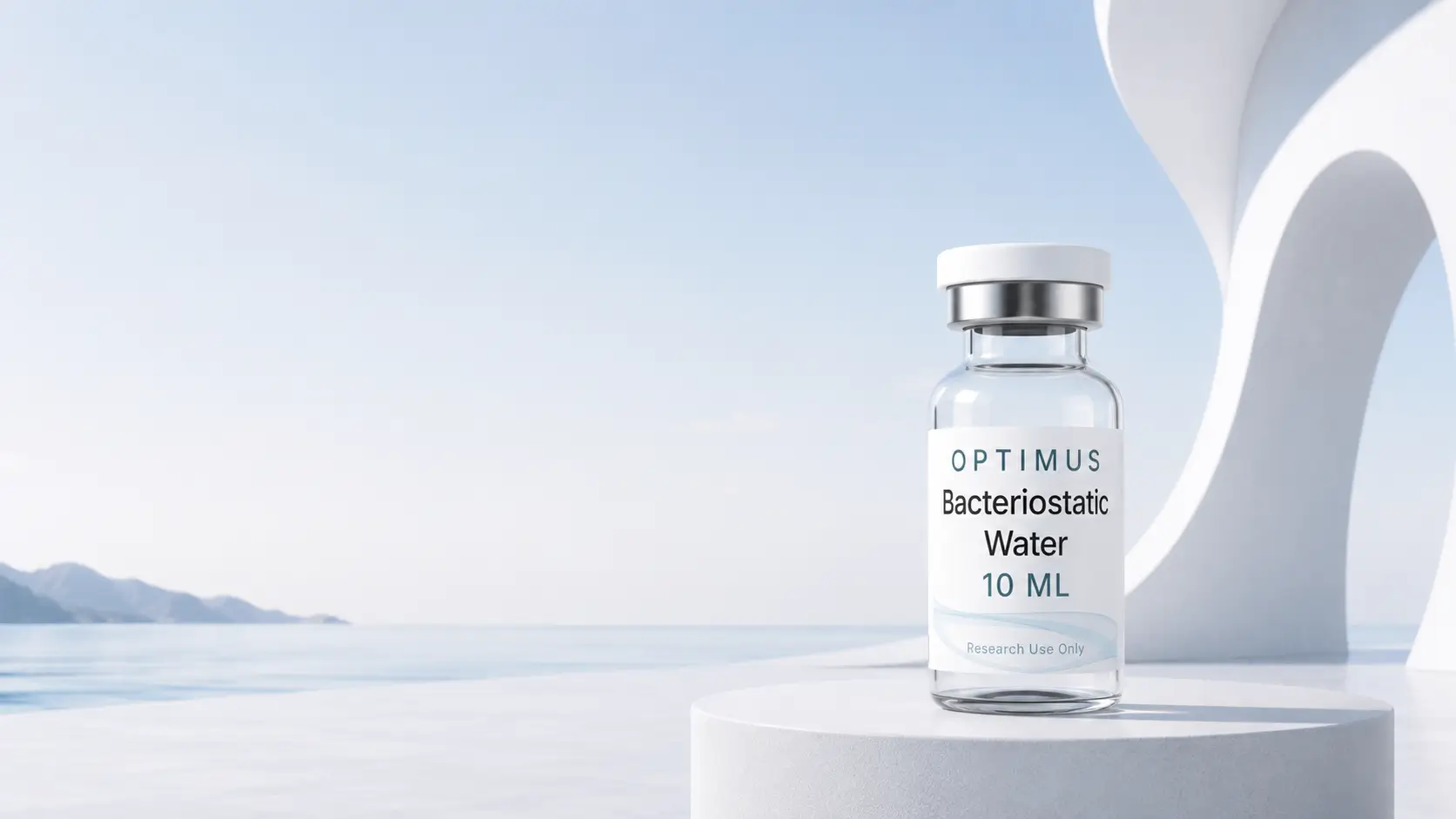
Bacteriostatic water (often shortened to bac water) is a sterile, non-pyrogenic solution containing 0.9% benzyl alcohol as a preservative. In research settings it is used as a solvent for dissolving and diluting lyophilised peptides and other research compounds. Because the benzyl alcohol inhibits bacterial growth, a single vial can be used across multiple withdrawals in a controlled laboratory environment. This guide explains what it is, how it differs from sterile water, how it is used to reconstitute research peptides, and how to store it correctly.
What Is Bacteriostatic Water?
Bac water is purified water combined with 0.9% benzyl alcohol. The benzyl alcohol acts as a bacteriostatic agent — it prevents the multiplication of most common bacteria rather than actively sterilising the solution. This is what allows a vial to remain suitable for repeated use once opened. You may also see it referred to as “bacteriostatic water for injection” in reference material, but here it is supplied strictly as a laboratory reagent for reconstituting and diluting research compounds.
Bacteriostatic Water vs Sterile Water: What’s the Difference?
The key difference is the preservative. Bac water contains 0.9% benzyl alcohol, which inhibits bacterial growth and permits multiple uses. Sterile water contains no preservative and is intended for single use, as it offers no protection against contamination once opened.
| Property | Bacteriostatic Water | Sterile Water |
|---|---|---|
| Preservative | 0.9% benzyl alcohol | None |
| Bacterial growth | Inhibited | Not inhibited |
| Usage | Multiple withdrawals | Single use |
| Shelf life after opening | Up to 28 days at 4°C | Immediate use |
| Typical lab use | Peptide reconstitution, dilutions | General lab work |
What Is Bac Water Used For?
In research laboratories, bac water is used wherever a compound needs to be brought into solution for repeated handling:
- Peptide reconstitution: dissolving lyophilised (freeze-dried) research peptides into a workable solution.
- Assay development: preparing standard solutions and serial dilutions for biochemical assays.
- Reagent preparation: creating working solutions from concentrated stock compounds.
How to Reconstitute Research Peptides With Bac Water
Reconstitution is the process of adding the solvent to a lyophilised peptide to return it to solution. The volume you add determines the final concentration, so it is worth calculating before you begin.
- Bring to room temperature: allow both the peptide vial and the water to reach room temperature.
- Use sterile technique: withdraw the water with a sterile syringe and needle.
- Add slowly: release it down the inside wall of the vial rather than directly onto the peptide pellet.
- Dissolve gently: swirl, do not shake. Allow the peptide to dissolve fully into solution.
- Store: refrigerate the reconstituted solution and any unused solvent at 4°C.
Example calculation: to reconstitute a 5 mg peptide with 2 mL of solvent, the resulting concentration is 2.5 mg/mL. Adjusting the volume changes the concentration without changing the amount of compound. Compounds such as GHK-Cu and other lyophilised peptides in our catalogue are supplied freeze-dried for this reason.
How to Store Bac Water
- Store unopened vials at room temperature, away from direct light.
- After opening, store at 4°C (refrigerated).
- Use within 28 days of first puncture; discard any remaining solution afterwards.
- Always inspect the solution before use — it should be clear and free of particles.
Frequently Asked Questions
What is bacteriostatic water used for?
It is used to dissolve and dilute research compounds, peptides and reagents in laboratory settings. The benzyl alcohol preservative allows a single vial to be used for multiple withdrawals.
Is bac water the same as bacteriostatic water?
Yes. “Bac water” is simply a common abbreviation; both refer to the same 0.9% benzyl alcohol solution.
How long does it last once opened?
It can be used for up to 28 days after opening when stored at 4°C. After 28 days, any remaining solution should be discarded.
What is the difference between bacteriostatic water and sterile water?
The former contains 0.9% benzyl alcohol as a preservative; the latter does not. That preservative inhibits bacterial growth, which is why one can be used repeatedly and the other cannot.
Can it be used for peptide reconstitution?
Yes. It is the standard choice for reconstituting lyophilised peptides in research applications, because it keeps the solution usable across multiple withdrawals.
Bacteriostatic Water for Research at Optimus Labs
Optimus Labs supplies bacteriostatic water as a sterile, non-pyrogenic solution with 0.9% benzyl alcohol, produced under controlled conditions for laboratory research. Each order ships from the UK with tracked delivery, and every product is backed by third-party HPLC testing — see why peptide purity matters for more on our testing standards. It is the standard solvent for reconstituting the most popular research peptides in the UK.