How to Read a Certificate of Analysis (COA) for Research Peptides

This content is for laboratory research purposes only. Not for human or animal use.
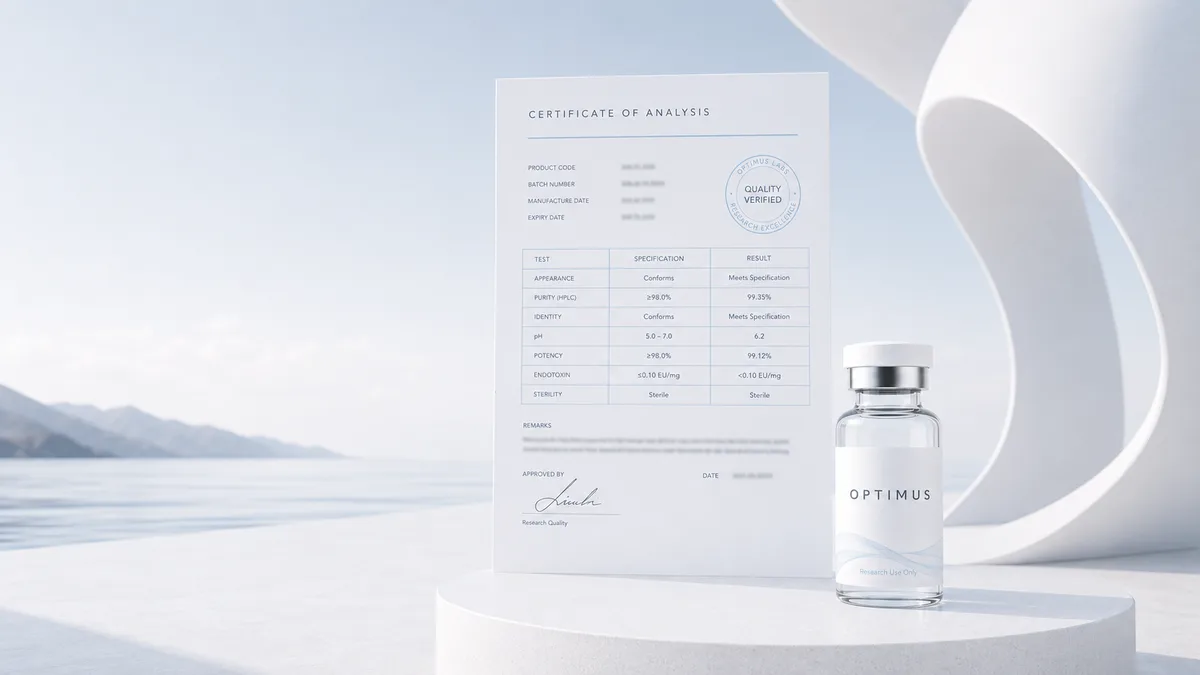
When you receive a vial of research peptides, the most important document included is the Certificate of Analysis (COA). This lab-issued report tells you exactly what is in the vial, how pure it is, and whether it meets advertised specifications.
For researchers who rely on reproducible data, knowing how to read a COA is essential. This guide walks you through the key sections of a standard peptide COA.
Basic Information at the Top
Every COA starts with identifying details:
- Product name and lot number – Matches the vial label. Always verify consistency.
- Molecular weight and formula – Confirms the peptide sequence is correct.
- Appearance – Should state “white lyophilized powder” or similar. Any discoloration or clumping may indicate degradation.
- Date of analysis – Fresher is better. Peptides degrade over time.
Red flag: Mismatched lot numbers between vial and COA. Do not use.
Purity (The Most Important Number)
Purity is typically measured by HPLC (High-Performance Liquid Chromatography). Look for:
- 98% or higher – Standard for most research applications
- 99% or higher – High purity for sensitive assays
- Below 95% – Likely contains significant impurities
Some COAs show a chromatogram (a graph with peaks). The main peak should be large and sharp, with few small side peaks. Each side peak represents an impurity.
What to check: The purity number should match what was advertised. If the COA says 98.5% but the listing said 99%, that is a discrepancy.
Mass Spectrometry (MS) Confirmation
HPLC tells you how much pure peptide is present. Mass spectrometry confirms which peptide is present.
Look for the observed mass versus calculated mass:
- Calculated mass – The theoretical molecular weight of your peptide
- Observed mass – What the mass spectrometer actually measured
Acceptable difference: Plus or minus 1.0 Da (Daltons) for most peptides. A larger difference suggests the wrong sequence or significant modification.
Example: Calculated: 1049.2 Da | Observed: 1049.5 Da – Good match.
Other Useful Metrics
Some COAs include additional tests:
- Acetate content – Residual counter-ion from synthesis (good range: less than 15%)
- Water content (Karl Fischer) – Moisture picked up during processing (good range: less than 5%)
- Endotoxin (LAL test) – Bacterial contamination (good range: less than 1.0 EU/mg for cell culture)
- Residual solvents – Trace synthesis chemicals (below specification)
For basic research (Western blots, ELISA, cell-free assays), purity and MS are usually sufficient. For cell culture or in vivo work, also check endotoxin levels.
What to Look For on a Certificate of Analysis (COA)
When reviewing a COA, focus on these key items:
- Purity percentage – Confirm it matches what was advertised (typically 98% or higher for research use).
- Observed mass vs. calculated mass – Should be within ±1.0 Da. This confirms peptide identity.
- Lot number match – Ensure the lot number on the COA matches the vial label.
- Date of analysis – Fresher is better.
- Appearance – Should state “white lyophilized powder” or similar.
Not every COA includes a printed chromatogram image, and that is fine. The numerical purity value and MS confirmation are the essential data points.
Quick Summary Checklist
Before using any research peptide, verify:
- Lot number matches vial
- Purity 98% or higher (or as required for your protocol)
- Observed mass within 1.0 Da of calculated
- Appearance is normal lyophilized powder
- No obvious contradictions (e.g., wrong molecular weight)
Need Help Interpreting a COA?
If you receive a COA and are unsure what the numbers mean, contact our research support team. We can help you understand the analytical data before you proceed with your experiments.
Optimus Labs supplies lab-tested research peptides, each provided with a downloadable Certificate of Analysis. Explore our Quality & Testing standards or browse the catalogue.