HPLC vs LC-MS: Understanding Peptide Purity Testing Methods


This content is for laboratory research purposes only. Not for human or animal use.
When evaluating research peptides, two analytical methods for peptide purity testing appear most frequently on Certificates of Analysis (COAs): HPLC and LC-MS. Both are essential, but they measure different properties. Understanding the difference helps researchers verify that a product meets their experimental requirements.
This guide explains what each method does, why both matter, and how to interpret the results.
What is HPLC?
HPLC stands for High-Performance Liquid Chromatography. It separates a sample into its individual components based on how they interact with a stationary phase (column) and a mobile phase (solvent).
What HPLC measures: Purity – specifically, the percentage of the target peptide relative to other compounds (impurities, truncated sequences, synthesis by-products).
How to read HPLC results on a COA:
- A single dominant peak = high purity
- Multiple smaller peaks = presence of impurities
- Purity percentage = area under the main peak divided by total area of all peaks
Acceptable range for research: Typically 95–99% depending on application. For most in vitro assays, 98% or higher is standard.
Limitation of HPLC alone: HPLC tells you how much pure material is present, but it does not confirm which compound that main peak represents. A contaminant could co-elute at the same retention time.
What is LC-MS?
LC-MS combines Liquid Chromatography (separation) with Mass Spectrometry (identification). The LC separates components, and the MS measures the exact molecular weight of each separated component as it elutes.
What LC-MS measures: Identity – specifically, the molecular weight of the peptide. This confirms that the main peak corresponds to the expected peptide sequence.
How to read LC-MS results on a COA:
- Look for observed mass (found) vs. calculated mass (expected)
- Acceptable difference: plus or minus 1.0 Da (Daltons) for most peptides
- A close match confirms the correct peptide is present
Example:
Calculated mass for BPC-157: 1419.6 Da
Observed mass: 1419.8 Da
Result: Confirmed identity
Limitation of LC-MS alone: LC-MS gives identity but not precise purity percentage (though it can estimate). HPLC remains the gold standard for quantifying purity.
Why You Need Both Methods
HPLC measures: Purity percentage. It is best for quantifying how pure the sample is. It cannot identify the compound.
LC-MS measures: Identity via mass confirmation. It is best for confirming it is the right peptide. It cannot measure exact purity.
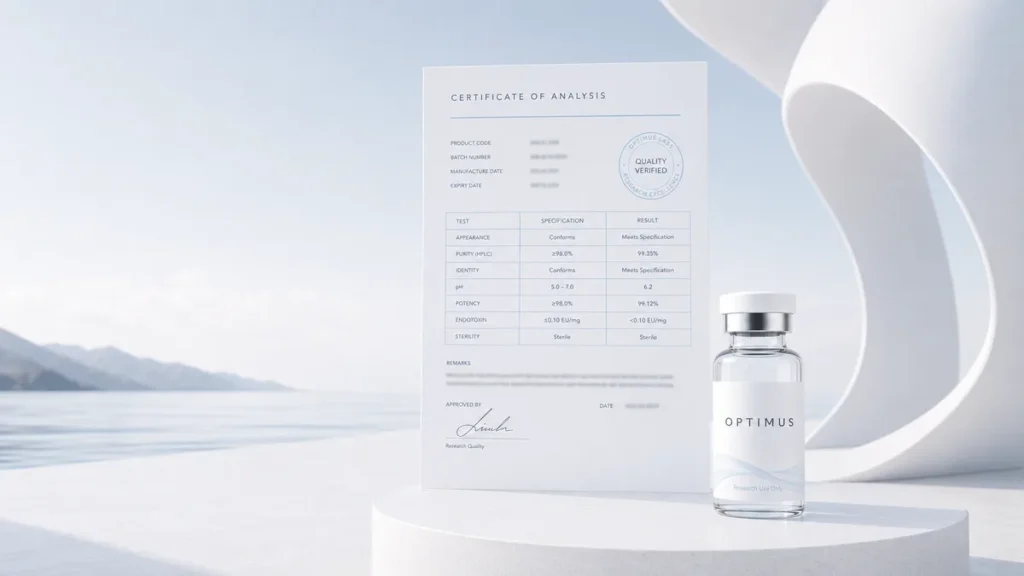
A reliable COA will include both HPLC purity and MS confirmation. If only one is present, the data is incomplete.
Example of a complete COA entry:
HPLC Purity: 98.7%
LC-MS (Observed Mass): 1419.8 Da (Calculated: 1419.6 Da)
Result: Identity confirmed. Purity meets specifications.
Additional Analytical Methods for Advanced Research
Depending on your research application, you may require more than HPLC and LC-MS:
- Amino Acid Analysis (AAA): Confirms exact composition of amino acids. Request for custom peptides.
- MALDI-TOF: Alternative mass confirmation for large peptides or proteins.
- Endotoxin (LAL test): Detects bacterial contamination. Required for cell culture or in vivo studies.
- Karl Fischer (Water content): Measures residual moisture. Useful for long-term storage stability assessment.
For most basic research (Western blot, ELISA, receptor binding assays), HPLC plus LC-MS is sufficient. For cell-based assays, add endotoxin testing.
What to Look For on a COA
When reviewing a COA, focus on these key items:
- Purity percentage – Confirm it matches what was advertised (typically 98% or higher for research use).
- Observed mass vs. calculated mass – Should be within ±1.0 Da. This confirms peptide identity.
- Lot number match – Ensure the lot number on the COA matches the vial label.
- Date of analysis – Fresher is better. Peptides degrade over time.
- Appearance – Should state “white lyophilized powder” or similar.
Not every COA includes a printed chromatogram image, and that is fine. The numerical purity value and MS confirmation are the essential data points. A chromatogram is a helpful supplement but not a requirement for a valid COA.
If the COA includes a purity number and MS data that both meet your specifications, and the lot number matches, the product is suitable for most research applications.
Peptide Purity Testing: Quick Summary
- HPLC = How pure? Target is 98% or higher.
- LC-MS = Which peptide? Observed mass should be within 1.0 Da of calculated.
- Both are required for a complete COA.
- Additional tests (endotoxin, AAA) may be needed for sensitive applications.
- Always verify lot numbers match between vial and COA.
Need Help Understanding Your COA?
If you have a COA from any supplier and are unsure whether the HPLC or LC-MS data meets your research needs, contact our lab support team for a second opinion.
Optimus Labs supplies lab-tested research peptides, each provided with a downloadable Certificate of Analysis. Explore our Quality & Testing standards or browse the catalogue.