What Is NAD+? A Research Overview

Disclaimer: This content is for laboratory research purposes only. Not for human or animal use.
Table of Contents
What Is NAD+?
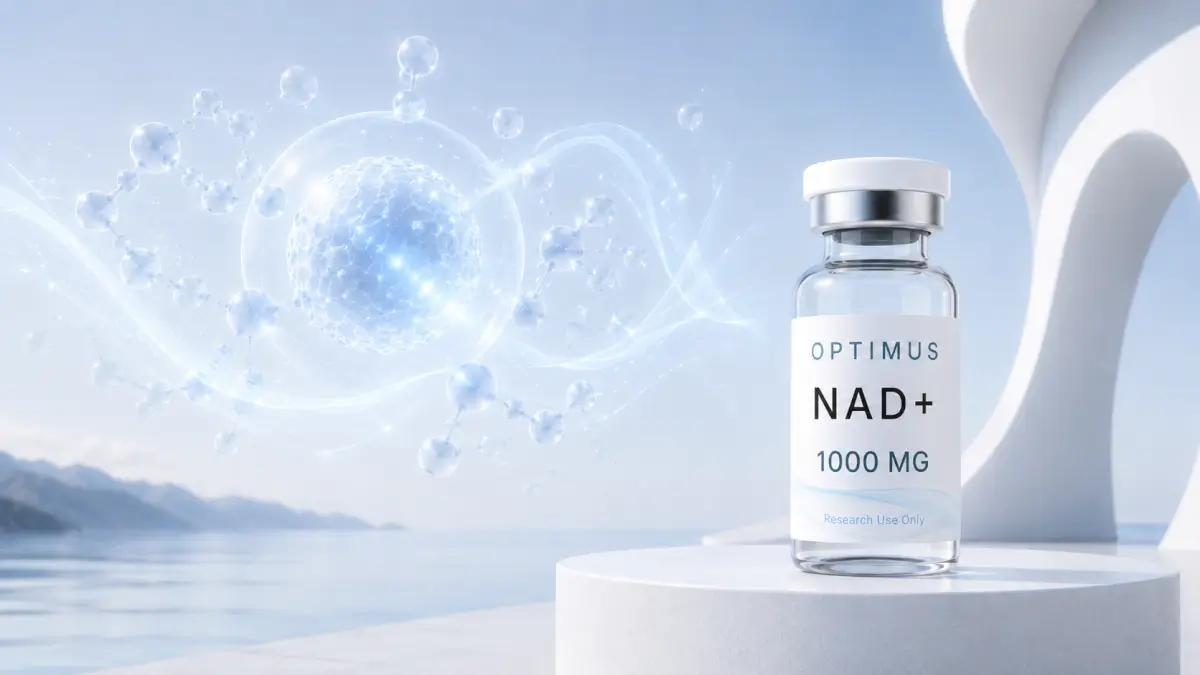
NAD+ (Nicotinamide Adenine Dinucleotide) is a coenzyme found in all living cells. It plays a central role in cellular energy metabolism, redox reactions, and signalling pathways. NAD+ is supplied as a lyophilised powder for controlled laboratory research investigations.
In scientific literature, NAD+ has been examined in experimental studies investigating cellular energetics, ageing mechanisms, and metabolic pathways within defined laboratory models.
How It Works
NAD+ functions as a coenzyme in redox reactions, transferring electrons from one molecule to another. It is also a substrate for several enzymes, including sirtuins and poly(ADP-ribose) polymerases (PARPs), which are involved in cellular signalling, DNA repair, and metabolic regulation.
Research suggests that NAD+ levels decline with age, making it a compound of interest for studies investigating cellular senescence, energy metabolism, and longevity.
Research Literature on NAD+
Three papers are cited at the end of this guide, and they sit at different distances from the bench. Covarrubias and colleagues (2021) published a review of NAD+ metabolism and the cellular processes associated with ageing. A review of that kind maps a field rather than reporting one experiment, so it is the sensible entry point for a reader approaching the area for the first time and wanting to see how the separate strands of the work fit together.
The other two are laboratory studies in aged rodent models, and both examine nicotinamide mononucleotide, a precursor within the same metabolic pathway, rather than the coenzyme itself. Wang and colleagues (2026) examined ovarian tissue and cultured oocytes from aged mice alongside a set of signalling and mitochondrial markers. Wen and colleagues (2026) examined cardiac tissue in an aged mouse dietary model, following a separate signalling pathway.
The references are given so that the primary sources can be consulted directly, and each paper’s own methods section is the place to look for what was measured and under what conditions. No published study cited here used material supplied by Optimus Labs.
NAD+ Research Applications
NAD+ has been referenced in controlled in-vitro and experimental laboratory studies examining:
- Cellular energy metabolism: Research into redox reactions and ATP production
- Sirtuin activation: Studies on NAD+-dependent enzymes and cellular health
- DNA repair mechanisms: Investigations into PARP-mediated DNA repair pathways
- Ageing and senescence pathways: Research into NAD+ decline and cellular ageing
- Neuroprotective research: Studies on NAD+ in neurodegenerative models
Set out as a list these read as five separate programmes, which is not quite how the literature divides. Sirtuins and PARPs both consume the same coenzyme, so a study framed around DNA repair and one framed around senescence may share a preparation and differ mainly in which readout is recorded. The list is best taken as the range of questions that have been put to this compound rather than as a set of self-contained fields.
NAD+ Purity and Quality
For reproducible results, confirm the identity and purity of the material before use. The specifications below are a useful checklist.
| Property | Specification |
|---|---|
| Appearance | White to off-white powder |
| HPLC purity | ≥98% (HPLC-verified) |
| Sequence | NAD+ (C₂₁H₂₇N₇O₁₄P₂) |
| Molecular weight | ~663.4 g/mol |
| Storage | -20°C, protected from light and moisture |
| COA | Confirms purity, molecular weight and identity |
Verifying Purity and Identity
Two analytical methods carry most of the weight behind a specification table like the one above. Reversed-phase HPLC separates the target molecule from process-related impurities and degradation products, and the purity figure quoted on a Certificate of Analysis is normally the area percentage of the main peak in that chromatogram. Mass spectrometry answers the other half of the question, confirming that the mass observed matches the mass calculated for the intended structure rather than for something that happens to elute nearby.
A Certificate of Analysis describes a batch, not a product line. It records which batch was tested, which methods were applied and what those methods returned. That distinction is what makes the certificate useful for reproducibility, because two batches of the same compound are not automatically identical and an experiment that cannot be traced to a particular batch is harder for anyone else to repeat. Filing the certificate with the experimental record and quoting the batch number in any write-up closes that gap before it opens.
The appearance row is worth reading rather than skipping. A visual description sets the expectation for what arrives in the vial, and a cake that looks unlike the description is a reason to check the certificate again before anything is dissolved. None of these checks are difficult, and doing them at the point of receipt is far cheaper than tracing an anomaly back through a completed experiment.
Reconstitution and Handling
NAD+ is supplied as a lyophilised powder and is brought into solution before use. For aqueous preparations, sterile water or buffer solutions are commonly used.
Bring the vial and solvent to room temperature, add the solvent gently down the inside wall, and swirl until fully dissolved. Aliquot the reconstituted solution and store frozen (-80°C for longer-term storage) to minimise freeze-thaw cycles.
Storage and Stability
Freeze-drying removes the water that makes a compound reactive, and the dry cake is by some distance the most durable state this material takes. Kept sealed in its original vial, frozen at the temperature given in the specification table and shielded from light, it will hold its specification far longer than the same material in solution. Moisture is the variable most easily overlooked, so let a cold vial reach room temperature before it is opened and reseal it without delay.
Once dissolved the material should be treated as a perishable reagent. Dividing the solution into single-use aliquots at the moment of reconstitution is the standard way to avoid returning to the same stock repeatedly, since every freeze-thaw cycle is an opportunity for loss. Label each aliquot with the compound, the batch number, the solvent and the date, and keep those details with the results they belong to. How long a given solution remains fit for a particular assay is a question best settled empirically for that assay.
Related Research Compounds
- SS-31 — mitochondrial function research; see our SS-31 guide.
- MOTS-c — mitochondrial and metabolic research; see our MOTS-c guide.
- KPV — inflammation and immune response research; see our KPV guide.
- Epitalon — cellular senescence and ageing research; see our Epitalon guide.
NAD+ in Laboratory Context
The compounds listed above are grouped together because the questions asked of them overlap, but they are not the same kind of material and the difference matters when a study is designed. This coenzyme is a small molecule that participates directly in redox chemistry and acts as a substrate for the enzymes named earlier. SS-31 and MOTS-c are peptides, and each meets mitochondrial biology at a different point, one through the inner membrane and the other as a peptide encoded by mitochondrial DNA.
KPV sits further away again, in the inflammation and immune literature rather than the energetics literature, and Epitalon is grouped here for its place in senescence and ageing work. The practical consequence is that these are complementary reference points rather than substitutes. A result obtained with one does not transfer to another, and a design that treats them as interchangeable arms of the same experiment will be difficult to interpret afterwards.
What the group does share is a literature that keeps returning to the same tissues and the same readouts, which is why guides to each of them cross-reference one another. Reading across the set is a reasonable way to place a single compound before committing to a design, and the guides linked above are written to be read that way rather than in isolation.
Frequently Asked Questions
What is NAD+ used for in research?
NAD+ is studied for its role in cellular energy metabolism, sirtuin activation, DNA repair, and ageing pathways.
How is NAD+ supplied?
NAD+ is supplied as a lyophilised powder in sterile vials, ready for reconstitution in research settings.
What purity should I look for?
For most research applications, ≥98% HPLC purity is recommended. Higher purity (≥99%) is preferred for sensitive assays.
What does lyophilised mean?
Lyophilisation is freeze-drying. The material is frozen and the water is then removed under vacuum, leaving a dry cake that is much more stable than the same material in solution and that returns to solution when solvent is added.
Why does the purity threshold matter for reproducibility?
Whatever is not the target compound is something else, usually process-related impurities or degradation products. If that fraction varies from batch to batch, a variable has entered the work that the experimental design does not account for, and results become harder to compare between runs.
What does a Certificate of Analysis confirm?
It states which batch was tested, which analytical methods were used and what they returned, including purity, molecular weight and identity. It speaks for that batch specifically rather than for the product line as a whole.
Why is the material supplied as a powder rather than a solution?
The dry form is the more stable one, and supplying it that way leaves the choice of solvent and concentration to the laboratory rather than fixing it in advance. It also means the material can be stored under the conditions in the specification table until the point at which it is needed.
For Research at Optimus Labs
Optimus Labs supplies NAD+ as a high-purity lyophilised powder, HPLC-verified and batch-tested, with a Certificate of Analysis confirming purity, molecular weight and identity. Orders ship from the UK with tracked delivery.
Explore the rest of the research catalogue for related laboratory compounds, or our overview of the most popular research peptides in the UK.
References
- Covarrubias AJ, et al. (2021). NAD(+) metabolism and its roles in cellular processes during ageing. Nat Rev Mol Cell Biol. – https://pubmed.ncbi.nlm.nih.gov/33353981/
- Wang J, et al. (2026). NMN Can Restore Ovarian Reserve in Aged Mice by Upregulating NAD(+)/SIRT1/PGC-1α Signaling Pathway and TOMM20 Expression, and Improve in Vitro Development of Aging Oocytes. Reprod Sci. – https://pubmed.ncbi.nlm.nih.gov/41951910/
- Wen X, et al. (2026). Nicotinamide Mononucleotide Improves High-Fat Diet-Induced Myocardial Damage of Aging Mice through the Sirt3/PINK1/Parkin Signaling Pathway. J Nutr. – https://pubmed.ncbi.nlm.nih.gov/41763569/