How to Store Peptides: 8 Essential Rules for the Lab

Disclaimer: This content is for laboratory research purposes only. Not for human or animal use.
Table of Contents
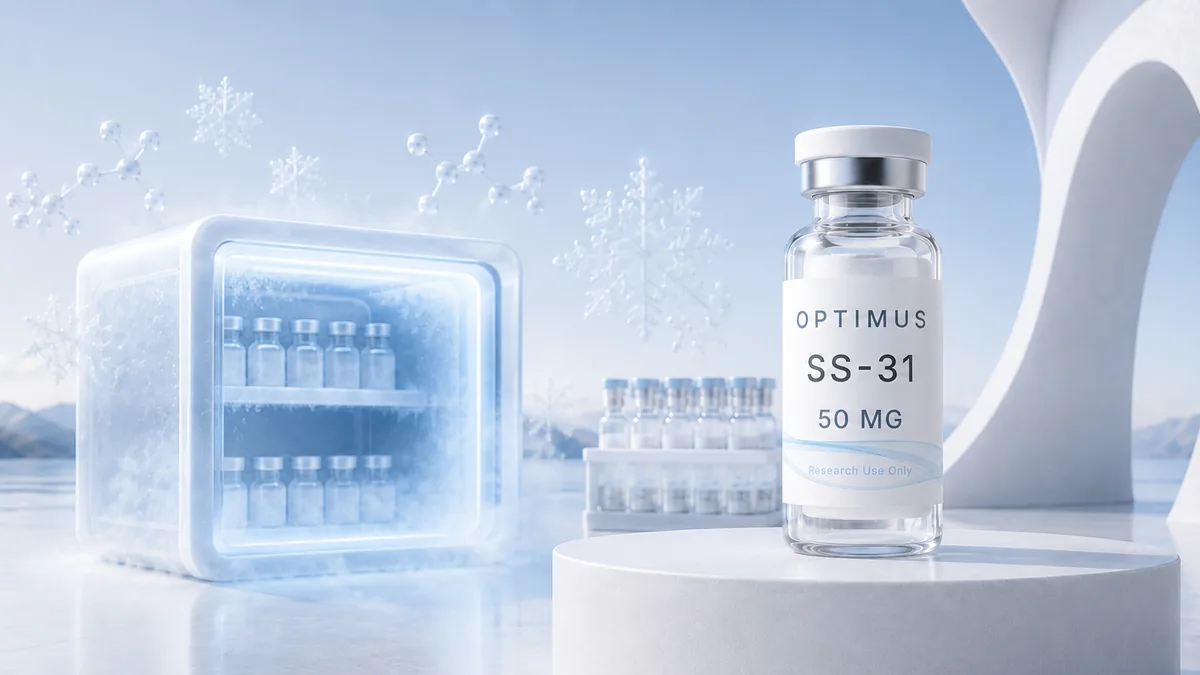
A sealed lyophilised peptide can hold its specification for years in a freezer. The same peptide in solution can lose it in days. Knowing how to store peptides is mostly about respecting that difference: keep the dry powder frozen, dry and dark, open it only when it has warmed, and treat anything you dissolve as a reagent with a short life.
This guide on how to store peptides sets out what the major peptide manufacturers recommend for lyophilised storage, shipping, opening, reconstitution and the residues that need extra care, and it says where their guidance differs.
Key takeaways
- Lyophilised peptides: -20 °C or colder, sealed, desiccated, away from light.
- Let a closed vial reach room temperature before opening it, to keep condensation off the powder.
- Solutions are perishable: a few days refrigerated, single-use frozen aliquots beyond that.
- Avoid freeze-thaw cycles; aliquot at the moment of reconstitution.
- Cysteine, methionine and tryptophan sequences oxidise and benefit from an inert-gas headspace.
How to store peptides in lyophilised form
The short answer to how to store peptides in their dry form: frozen, sealed, dry and out of the light. Every manufacturer guideline we checked keeps lyophilised peptides frozen. GenScript and Sigma-Aldrich give -20 °C, JPT gives -20 °C to -80 °C, and Bachem sets its floor at -15 °C with -50 °C or lower preferred for long-term storage. GenScript describes most lyophilised peptides as stable for several years at -20 °C, and JPT says the same across its range, with periodic stability testing for anything held that long.
The reason the dry cake lasts so well is that freeze-drying removes the water that makes a peptide reactive. That is also why moisture is the variable most often overlooked. Sigma-Aldrich puts it bluntly: exposure to moisture greatly decreases long-term stability. Keep the vial in its original closed container, ideally inside a desiccator or a box with desiccant sachets, and keep it away from bright light, which can degrade light-sensitive residues.
- Temperature: -20 °C as the floor, -80 °C where available.
- Container: the original vial, tightly closed, in a desiccated box.
- Light: dark storage, an amber vial, or opaque outer packaging, as NIBSC advises.
- Record: batch number, date received and date opened, kept with the certificate of analysis.
What happens to peptides during shipping?
Short periods at ambient temperature during transit do not undo the stability of a sealed lyophilised vial. Bachem states that lyophilised peptides may be shipped at room temperature and, for short-term use, kept in a refrigerator, and LifeTein says the same. JPT, by contrast, recommends dry ice. NIBSC, the UK standards institute, puts the tolerance of dry peptides at room temperature at days to weeks, with -20 °C preferred for long-term storage. What matters is what happens on arrival: the vial should go into the freezer the same day, still sealed, once the batch number on the label has been checked against the certificate of analysis on the product page.
No manufacturer gives a transit limit in days, and NIBSC’s days to weeks is the nearest thing to a figure, so we do not invent a tighter one. UK orders from Optimus Labs travel by tracked Royal Mail, one to four days depending on the service, well inside the routine handling a sealed lyophilised vial is made for.
Why let a vial reach room temperature before opening it?
Because a cold vial opened in warm air pulls moisture straight onto the powder. GenScript, Sigma-Aldrich and Bachem all give the same instruction: allow the closed vial to equilibrate to room temperature before removing the cap. Bachem adds that this is best done in a desiccator, since moisture taken up by the cake reduces the true peptide content and can reduce stability from that point on.
No source specifies how long this takes. In practice a small vial from a -20 °C freezer reaches ambient temperature within a short wait on the bench, and the test is simple: no condensation on the outside of the glass. Open it, take what the work needs, and reseal without delay. If the powder is to be weighed rather than dissolved in the vial, do the weighing quickly and return the vial to storage. LifeTein adds a practical step before reconstitution: a brief spin in a centrifuge, so the cake sits at the bottom of the vial rather than in the cap or on the walls.
How long do peptides last after reconstitution?
Not long, compared with the dry powder, and this is where most peptide storage goes wrong. Once a peptide is in solution it should be treated as a perishable reagent. JPT allows refrigerated storage at 4 °C for a few days when the solution is for short-term use. GenScript and Bachem go further and advise against holding solutions at all if it can be avoided, and where it cannot, they recommend dividing the solution into single-use aliquots at the moment of reconstitution and freezing them: GenScript at -20 °C or preferably -80 °C, Bachem below -15 °C, where it says frozen solutions may be kept for a few weeks.
The aliquoting step matters more than the exact temperature. Each freeze-thaw cycle is an opportunity for loss, through aggregation in particular. JPT and Sigma-Aldrich say in so many words that repeated freeze-thaw cycles should be avoided, and the aliquoting advice from GenScript and Bachem exists for the same reason. One tube per use means the bulk never thaws. GenScript also notes that solutions are open to bacterial degradation, which the dry powder is not, so clean technique when preparing them is part of storage, not separate from it.
Solution chemistry plays a part too. JPT prefers mildly acidic solutions, pH 4 to 6, to reduce the two most common degradation routes in solution, aggregation and deamidation; GenScript gives pH 5 to 6, and Bachem notes that deamidation accelerates above pH 6. A 2021 study of exenatide in Pharmaceutics examined exactly this, comparing degradation across a pH range and set of excipients, and is worth reading for anyone designing a buffer for a sensitive sequence.
Container material matters for solutions as well. AAPPTEC notes that hydrophobic peptides adsorb onto polypropylene, so their solutions belong in glass or low-binding tubes; in a dilute solution the loss to the tube wall can be a large share of what was dissolved.
- A few days: refrigerated at 2 to 8 °C is acceptable for short-term use.
- Beyond that: single-use aliquots, frozen at -20 °C or colder.
- Never: repeated freeze-thaw of one stock tube.
- Always: label each aliquot with compound, batch, solvent and date.
Which peptides need extra care?
Sequence decides how forgiving a peptide is, and how to store peptides with sensitive residues differs in one or two details. Three groups of residues come up in every manufacturer guideline, and they fail in different ways.
- Cysteine, methionine and tryptophan oxidise. Sigma-Aldrich recommends purging the vial headspace with nitrogen or argon before recapping, GenScript recommends purging buffers with the same gases, and Bachem recommends oxygen-free water or buffers for solutions of these peptides.
- Asparagine and glutamine deamidate, a slow hydrolytic change that acidic buffers and cold storage both slow down. Bachem lists these alongside the oxidation-prone residues as having a limited shelf life in solution.
- Aspartate, glutamate, lysine, arginine and histidine are hygroscopic. GenScript flags peptides rich in these residues as prone to absorbing moisture from the air, which is a different problem from oxidation and is solved by desiccated storage and short open times rather than by inert gas.
The practical consequence is that the same freezer, the same desiccator and the same aliquoting habit serve every peptide, but a sequence in the first group also benefits from an inert atmosphere, and a sequence in the third group is the one most punished by a vial left open on the bench.
How to store peptides: a laboratory checklist
- On arrival, match the batch number on the label to the certificate of analysis, then freeze the sealed vial.
- Store at -20 °C or colder, in the dark, in a closed box with desiccant. This is how to store peptides for the long term.
- Before opening, let the closed vial reach room temperature until the glass is dry.
- Open briefly, take what is needed, reseal, and return to the freezer.
- If reconstituting, prepare only what the work needs, in a mildly acidic buffer where the method allows.
- Aliquot immediately into single-use tubes and freeze anything not used within a few days.
- Label every tube with compound, batch, solvent and date, and keep the handling record with the certificate.
- For cysteine, methionine or tryptophan sequences, purge the headspace with inert gas before resealing.
Where the storage guidance differs between suppliers
Ask four manufacturers how to store peptides and you get one direction and four sets of numbers, which is worth knowing before treating any single figure as a rule. On the long-term freezer temperature, GenScript is content with -20 °C for years, JPT and Sigma-Aldrich prefer -80 °C, and Bachem sets the floor at below -15 °C with -50 °C or lower preferred. On solutions, JPT sanctions a few days in the fridge while GenScript and Bachem go straight to frozen aliquots. On shipping, Bachem and LifeTein say in writing that room-temperature transit is acceptable, JPT recommends dry ice, and NIBSC’s days to weeks at room temperature is the only duration anyone gives.
Two things no manufacturer guideline covers at all: visual signs that a lyophilised cake has degraded, and a checklist for inspecting a vial on arrival. We have not invented either. A cake can look unchanged and still have lost content to moisture, which is why the record of when a vial was received, opened and reconstituted, read alongside the batch certificate, is a better guide to the material’s state than its appearance.
Frequently asked questions
Can peptides be stored in the fridge instead of the freezer?
Lyophilised vials belong in the freezer, and that is the first rule of how to store peptides. Bachem allows refrigeration for short-term use only, and every source puts long-term storage at -20 °C or colder. Reconstituted solutions can sit at 2 to 8 °C for a few days; beyond that they should be aliquoted and frozen.
Can lyophilised peptides be kept at room temperature?
Only for short periods. NIBSC puts the tolerance of dry peptides at room temperature at days to weeks, and no supplier treats it as a storage condition. Freeze the vial on the day it arrives.
Does freezing damage peptides?
Freezing itself is the recommended state for both the powder and, in aliquots, the solution. What causes loss is repeated freezing and thawing of the same tube, which is why the solution is divided into single-use portions before it is frozen.
How can I tell if a peptide has degraded?
Not reliably by eye. No manufacturer guideline lists visual indicators for the lyophilised cake, and a vial that has taken up moisture can look unchanged. Analytical confirmation by HPLC purity and mass spectrometry identity is the only real answer, and that is what the batch certificate of analysis provides for the material as supplied. After that, the handling record is the best evidence of its state.
Do all peptides need a -80 °C freezer?
No. -20 °C is the figure most guidelines give, Bachem’s floor is -15 °C, and GenScript rates -20 °C as sufficient for years. A -80 °C freezer is preferred where available, and matters most for sequences with oxidation-prone or deamidation-prone residues held for long periods.
What if the freezer fails?
A sealed lyophilised vial tolerates a period at ambient temperature, so a short power cut is not a loss; note it in the handling record. Frozen solutions that thawed have had a freeze-thaw cycle, which is the thing to record and, for anything that matters, to avoid repeating. Frost-free domestic freezers also warm briefly during each defrost cycle, which a laboratory or manual-defrost freezer does not, so a vial that must sit in a domestic freezer belongs at the back, in its box.
Peptide storage terms explained
Storage guidance from manufacturers assumes a few terms. These are the ones that matter for how to store peptides correctly.
- Lyophilised: freeze-dried. The peptide solution is frozen and the ice removed under vacuum, leaving a dry cake or powder in the vial. This is the form in which peptides are supplied and the form in which they keep longest.
- Cake: the solid left after freeze-drying, which may look like a small white disc, a loose powder, or a thin film on the glass. Appearance varies by peptide and by fill and is not a quality signal on its own.
- Reconstitution: dissolving the lyophilised peptide in a solvent to make a solution. From this point the peptide is perishable and the storage rules for solutions apply.
- Aliquot: a single-use portion of a solution, divided out at reconstitution so that the bulk is never thawed and refrozen.
- Freeze-thaw cycle: one round of freezing a solution and thawing it. Each cycle risks aggregation and loss, which is why aliquots exist.
- Desiccator: a sealed container holding a drying agent, used to keep vials dry in storage and while they warm to room temperature before opening.
- Deliquescence: a solid absorbing enough moisture from the air to begin dissolving. GenScript uses the term for peptides rich in aspartate, glutamate, lysine, arginine or histidine.
- Deamidation and oxidation: the two chemical changes most often behind loss in solution. Deamidation affects asparagine and glutamine and speeds up above pH 6; oxidation affects cysteine, methionine and tryptophan and is slowed by keeping oxygen away.
- Certificate of analysis: the batch document stating measured purity and confirmed identity for the material as supplied. It is the reference point for every later decision about how to store peptides from that batch and how long to keep them.
Storage at Optimus Labs
Every product in the Optimus Labs catalogue is supplied as a lyophilised powder with a batch certificate of analysis on its product page, and each Technical data tab states how to store peptides of that compound. Our quality testing page explains how purity and identity are confirmed and how to read the certificate.
Browse the research catalogue, or start with our overview of the most popular research peptides in the UK.
References
- JPT Peptide Technologies. How to Store Peptides: Best Practices for Researchers. https://www.jpt.com/blog/how-to-store-peptides/
- Bachem. Handling and Storage Guidelines for Peptides. https://www.bachem.com/knowledge-center/handling-and-storage-guidelines-for-peptides/
- GenScript. Peptide Storage and Handling Guidelines. https://www.genscript.com/peptide_storage_and_handling.html
- Sigma-Aldrich (Merck). Handling and Storage Guidelines for Peptides and Proteins. https://www.sigmaaldrich.com/US/en/technical-documents/technical-article/research-and-disease-areas/cell-and-developmental-biology-research/handling-and-storage
- NIBSC. Peptide Storage. https://nibsc.org/science_and_research/virology/cjd_resource_centre/available_samples/peptide_library/peptide_storage.aspx
- AAPPTEC. Handling and Storage of Peptides, FAQ. https://www.peptide.com/faqs/handling-and-storage-of-peptides/
- LifeTein. How to Store and Handle Synthesized Peptides. https://www.lifetein.com/How-to-store-and-handle-synthesized-peptides.html
- Benet A, et al. (2021). The Effects of pH and Excipients on Exenatide Stability in Solution. Pharmaceutics. – https://pubmed.ncbi.nlm.nih.gov/34452224/