Understanding Trifluoroacetic Acid (TFA) Removal in Peptide Manufacturing

This content is for laboratory research purposes only. Not for human or animal use.
Trifluoroacetic acid (TFA) is commonly used in peptide synthesis and purification. While effective, residual TFA can interfere with certain experiments. This guide explains what TFA is, why it matters, and when you should consider TFA removal.
What Is TFA and Why Is It Used?
TFA is a strong organic acid used in solid-phase peptide synthesis (SPPS) and HPLC purification. It helps:
- Remove protecting groups during synthesis
- Improve peptide solubility during purification
- Create sharp peaks in HPLC chromatograms
After synthesis, most peptides are isolated as TFA salts. This means TFA counter-ions are bound to the peptide.
When Is Residual TFA a Problem?
For most research applications, residual TFA is not an issue. However, it can cause problems in sensitive experiments:
- Cell culture – TFA can be toxic to cells at concentrations above 50–100 µM.
- Enzyme assays – Low pH from TFA may alter enzyme activity.
- Mass spectrometry – TFA suppresses ionization in some MS modes.
- Structural studies (NMR) – TFA peaks can interfere with spectra.
If your experiment involves live cells, sensitive enzymes, or high-precision analytics, TFA removal may be necessary.
How Is TFA Removed?
Several methods can reduce or remove residual TFA:
- Lyophilization with dilute HCl – Exchanging TFA for chloride ions.
- Ion exchange chromatography – Passing the peptide through a TFA-removal resin.
- Repeated lyophilization from acetic acid – Less effective but simpler.
- HPLC with alternative ion-pairing agents – Using formic acid or ammonium bicarbonate instead.
Each method has trade-offs in yield, time, and cost. Most suppliers offer TFA removal as a custom service.
How to Know If You Need TFA-Free Peptide
Ask these questions:
- Are you working with live cells? If yes, TFA-free is recommended.
- Is your assay pH-sensitive? If yes, consider TFA removal.
- Are you doing precise MS or NMR? If yes, request TFA-free.
- Is this a routine Western blot or ELISA? TFA is fine.
For the majority of basic research applications (binding assays, activity screens, antibody production), TFA salts are perfectly acceptable.
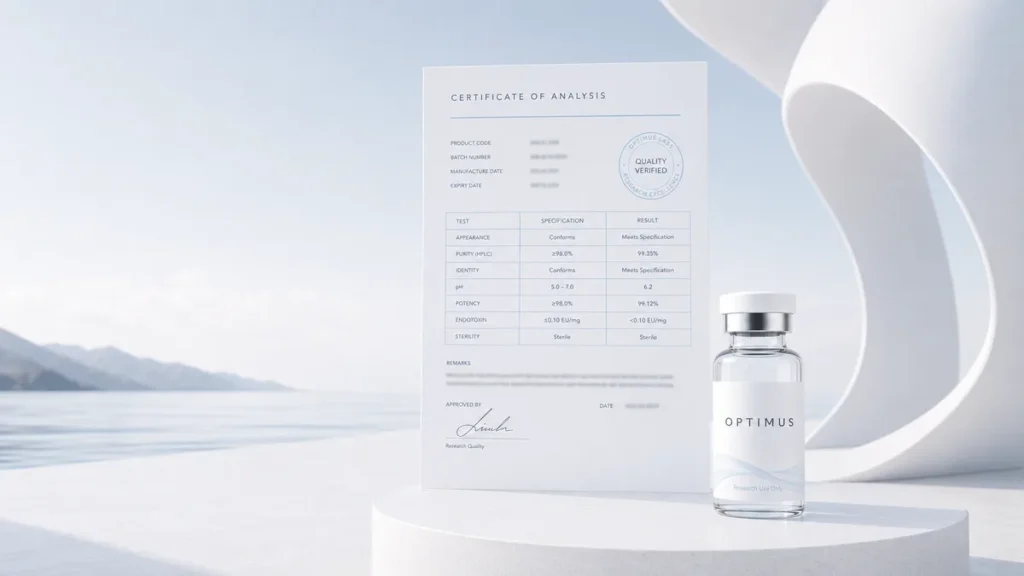
What to Look For on the COA
A COA may indicate:
- “TFA salt” – standard form, contains residual TFA.
- “Acetate salt” – TFA has been exchanged for acetate, which is less toxic.
- “TFA content” – some COAs report residual TFA percentage (typically <1–5%).
- “TFA-free” or “custom salt form” – specially processed for sensitive applications.
If you need TFA-free, request it before purchasing – it requires additional processing.
TFA Removal: Quick Summary
- TFA is a standard counter-ion in most research peptides.
- For cell culture, sensitive assays, or MS/NMR, consider TFA removal.
- TFA-free peptides are available as a custom option (higher cost).
- For routine lab work, TFA salts are reliable and cost-effective.
Need a TFA-Free Version of a Peptide?
If your experiments require TFA removal or an alternative salt form (acetate, HCl), contact our research support team to discuss custom options.
Optimus Labs supplies lab-tested research peptides, each provided with a downloadable Certificate of Analysis. Explore our Quality & Testing standards or browse the catalogue.