Understanding Peptide Purity Grades: Research vs Analytical vs Crude

This content is for laboratory research purposes only. Not for human or animal use.
When purchasing research peptides, you may encounter different peptide purity grades: crude, research grade, and analytical grade. Understanding the differences helps researchers select the appropriate quality level for their specific experiments without overspending.
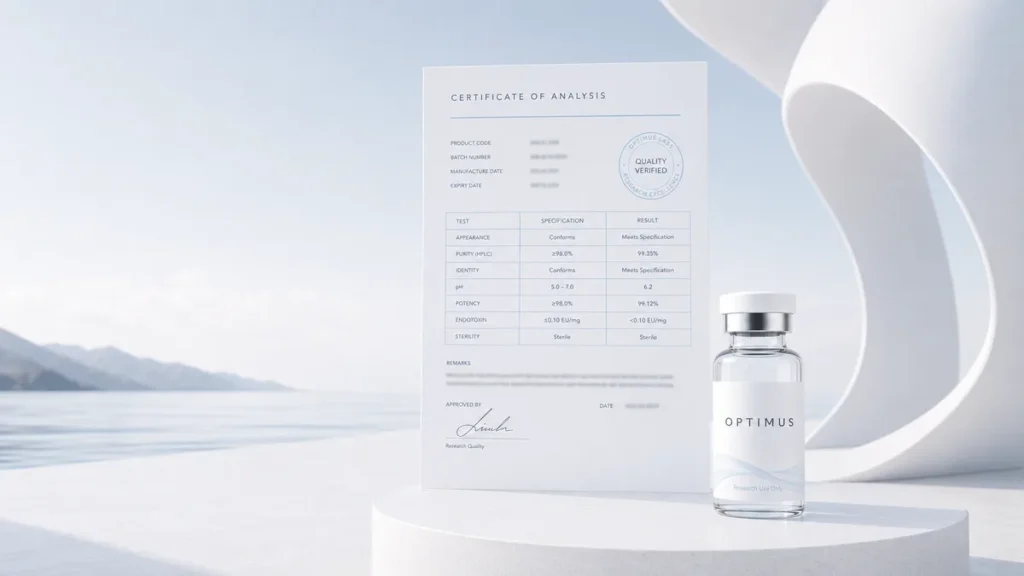
This guide explains each purity grade, typical applications, and what to expect from a Certificate of Analysis (COA).
Crude Peptides (Typically 50–85% Purity)
Crude peptides are synthesized and minimally purified, usually by simple precipitation or desalting.
Characteristics:
- Contains the target peptide plus truncated sequences, synthesis by-products, and residual reagents
- No HPLC purification step
- Lowest cost
Common applications:
- Initial screening assays where exact purity is not critical
- Antibody production (impurities may enhance immune response in some cases)
- Pilot experiments before investing in higher purity
Limitations:
- Impurities can interfere with binding or activity assays
- Not suitable for quantitative or cell-based studies
- Results may not be reproducible between batches
When to use: Exploratory research only. Not recommended for most in vitro or cell culture work.
Research Grade (Typically 90–98% Purity)
Research grade peptides are purified by HPLC (High-Performance Liquid Chromatography) to remove most impurities. This is the most common grade for general laboratory use.
Characteristics:
- Single HPLC purification pass
- Purity typically between 90% and 98%
- COA includes purity percentage and often mass spectrometry confirmation
- Moderate cost – good balance of quality and price
Common applications:
- Enzyme activity assays
- Receptor binding studies
- Western blotting and ELISA
- Cell-free assays
- Most standard in vitro experiments
Limitations:
- May contain minor impurities (2–10%) that could affect highly sensitive assays
- For live cell cultures, check endotoxin levels separately
When to use: Recommended for the majority of research applications. Cost-effective and reliable for most lab experiments.
Analytical Grade (Typically 98–99.5%+ Purity)
Analytical grade (also called “high purity” or “ultra-pure”) peptides undergo multiple HPLC purification passes and rigorous quality control.
Characteristics:
- Two or more HPLC purification cycles
- Purity typically 98% to over 99.5%
- Comprehensive COA with HPLC chromatogram, mass spectrometry, and often additional tests (water content, acetate, endotoxin)
- Highest cost
Common applications:
- Quantitative structure-activity relationship (QSAR) studies
- NMR spectroscopy or crystallography
- Cell culture and in vivo research (when endotoxin-tested)
- Critical experiments requiring absolute precision
Limitations:
- Higher cost may not be justified for routine assays
- Overkill for simple screening or antibody production
When to use: When experimental precision is paramount, or when impurities in lower grades have been shown to interfere with your specific assay.
How to Read Purity Claims on Supplier Websites
Some suppliers advertise “99% purity” but provide only a basic COA. Here is what to look for:
- For “HPLC purity 98%” – The COA should show HPLC chromatogram or at least numerical purity value.
- For “Mass confirmed” – The COA should list observed mass vs. calculated mass (within ±1.0 Da).
- For “Greater than 99%” – Multiple HPLC runs or extended purification. Ask for the raw chromatogram.
- For “Endotoxin tested” – Should state EU/mg value (e.g., less than 1.0 EU/mg) and test method (LAL).
If a supplier cannot provide a COA with both HPLC purity and MS confirmation, treat purity claims as unverified.
Matching Purity to Your Research
Use this simple guide:
- Exploratory or screening research – Crude (but not recommended for most labs)
- Standard in vitro assays (Western blot, ELISA, binding) – Research grade (90–98%)
- Cell culture or in vivo research – Analytical grade with endotoxin testing (98% or higher)
- Structural studies (NMR, crystallography) – Analytical grade (99% or higher)
For most researchers, research grade (95–98%) is the sweet spot – high enough purity for reliable data, without paying for ultra-high purity that is unnecessary for the application.
Peptide Purity Grades: Quick Summary
- Crude (50–85%): Minimal purification. Not recommended for most research.
- Research grade (90–98%): One HPLC pass. Suitable for most in vitro assays.
- Analytical grade (98–99.5%+): Multiple HPLC passes. Required for cell culture, in vivo, and structural studies.
- Always request a COA with HPLC purity and MS confirmation before purchasing.
Need Help Choosing the Right Grade?
Not sure which purity grade is appropriate for your experiment? Contact our research support team with details about your application, and we can guide you to the right product.
Optimus Labs supplies lab-tested research peptides, each provided with a downloadable Certificate of Analysis. Explore our Quality & Testing standards or browse the catalogue.